
Clinical protocol Hip & buttock
Piriformis syndrome (pseudo-sciatica)
Deep gluteal sciatic nerve irritation that mimics L5–S1 radiculopathy. Sustained sitting is the main aggravating load, which makes seating the one part of the plan the patient controls all day. Assessment, differentials, and a phased plan with the seating it needs.
Filed underPiriformis syndromeHip & buttock
Patient explainer
A 72-second explainer in plain words, made for your patients. Play it in the session, or send the patient view: the same video with the home plan and nothing clinical.
Clinical summary
- What it is
- Entrapment or irritation of the sciatic nerve by the piriformis in the deep gluteal space. Buttock pain with or without posterior thigh radiation; a diagnosis of exclusion.
- How common
- An estimated 0.3–6% of low-back-pain and sciatica presentations. More often in middle-aged adults; female to male about 6:1.
- Key tests
- FAIR, Freiberg, Pace, Beatty; seated piriformis stretch plus active piriformis test (sensitivity 0.91, specificity 0.80 together). Neurological screen usually normal.
- Rule out first
- Lumbar radiculopathy, SIJ pain, proximal hamstring tendinopathy, ischiofemoral impingement, and the red flags below.
- First line
- Conservative: load management, soft tissue work, stretching, neural mobilisation, hip abductor and external rotator strengthening. Most improve in 1–3 weeks of regular exercise.
- Seating
- Cut sustained sitting load: breaks every 30–45 min, no back-pocket wallet, no crossing the symptomatic leg, and a pressure-redistributing cushion.
Seating adjunct
Frido Cloud Seat Cushion ₹1,899 ₹2,899
Slim Seat Cushion if 5 cm of lift would upset desk, foot or pedal reach; Portable Travel Seat Cushion added for commuters and frequent flyers.
An adjunct that reduces sitting pressure. Not a treatment for sciatica.
The plan in three stages
1Relieve
Take the pressure off the nerve so the ache settles.
- Break up sitting: stand up and move every 30 to 45 minutes.
- Sit on a memory foam cushion on the chair you use most, so your weight spreads instead of landing on the sore spot.
- Stretch gently: the figure-4 stretch (demo video, opens in a new tab), 30 seconds, 3 times, 2 to 3 times a day. A stretch, never pain.
- Painkillers only as your doctor advises.
More on this: Management protocolWhy seating matters, and how a cushion helps
2Restore
Keep the nerve calm through the long hours of sitting.
- Take your wallet out of your back pocket.
- Don't sit with the sore leg crossed over the other.
- Set up the seat: feet flat, desk at elbow height, and check you still reach the car pedals.
- Breaks matter more than any cushion: keep standing up every 30 to 45 minutes.
More on this: Why seating matters, and how a cushion helpsTalking to the patient
3Reinforce
Strengthen the hip so the pain doesn't come back.
- From about week 2, hip strength as your physio sets it: clamshells (demo video, opens in a new tab), side-lying leg lifts (demo video, opens in a new tab) and bridges (demo video, opens in a new tab), 2 to 3 sets of 10 to 15, 3 times a week.
- From week 6, build back up to running, stairs and sport gradually.
- Keep a short stretch and strength routine once you're better.
- See your physio or doctor if it hasn't eased after 3 weeks, or your leg feels weak.
More on this: Management protocol
Anatomy and pathomechanics
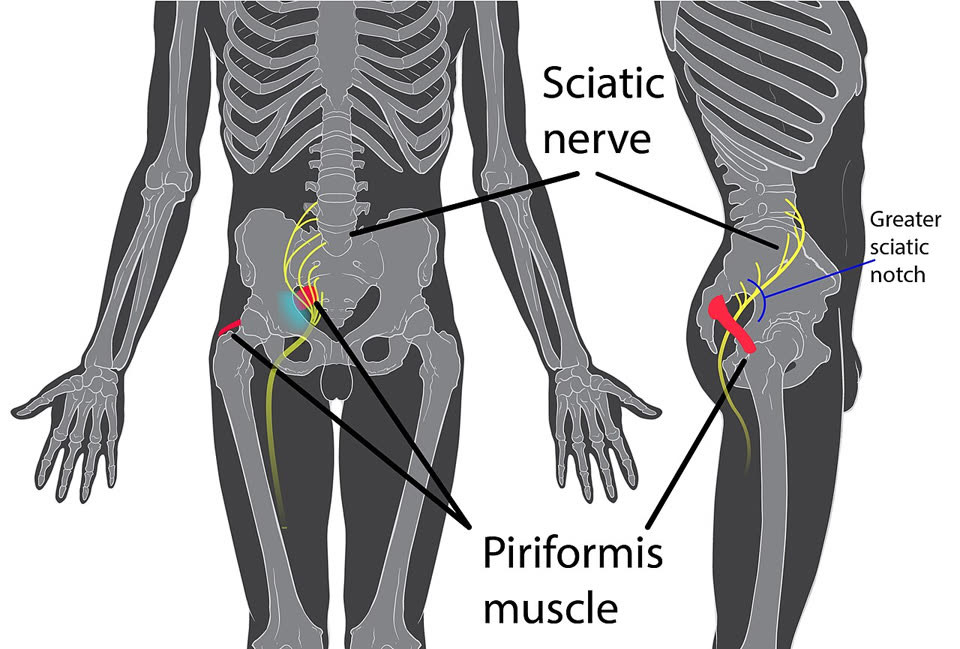
The piriformis arises from the anterior surface of the sacrum (S2–S4), the margin of the greater sciatic foramen and the sacrotuberous ligament, and inserts on the superior border of the greater trochanter. It is supplied by the nerve to piriformis (S1–S2, often with L5). It laterally rotates the extended hip and abducts the flexed hip; past roughly 60–90° of flexion its rotational action reverses towards internal rotation.
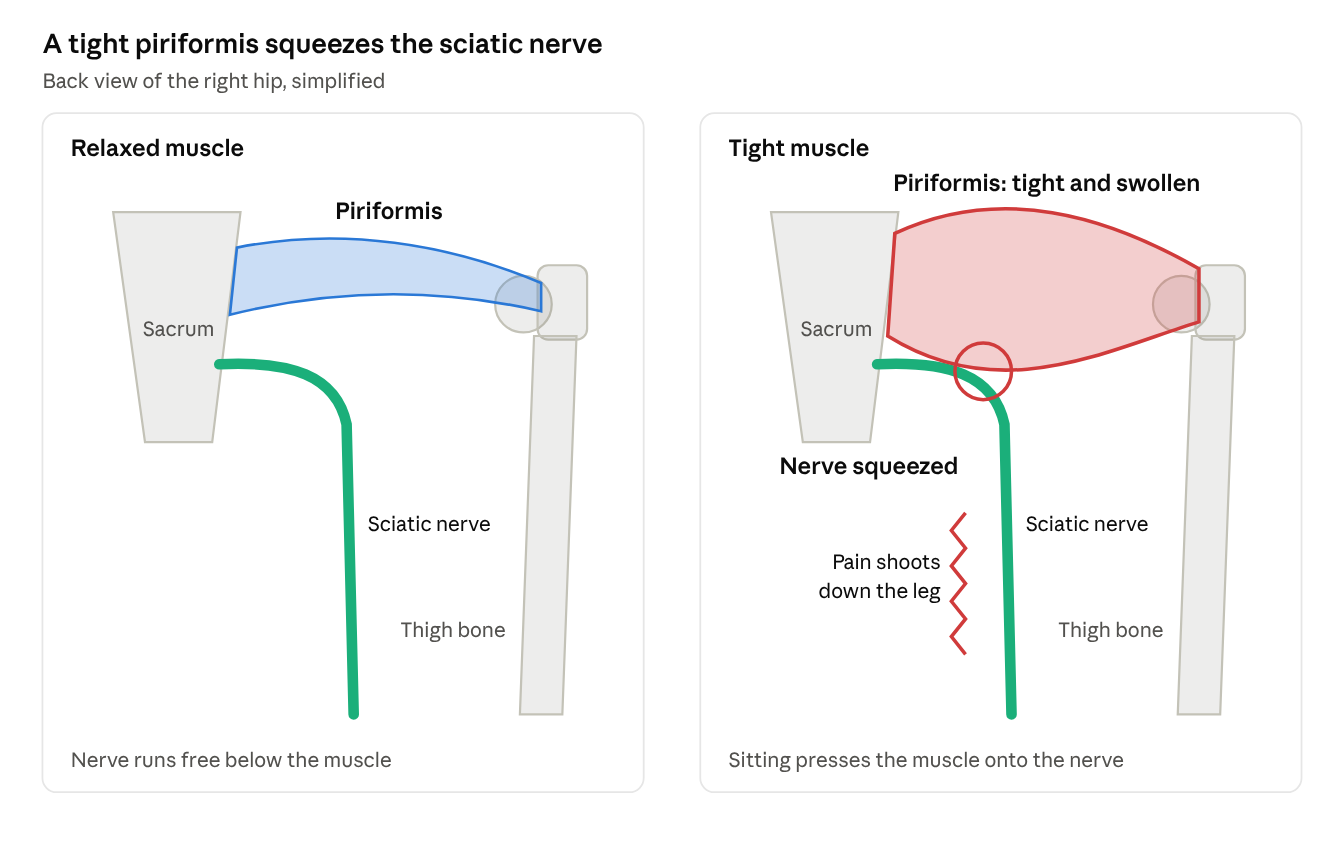
Passing through the greater sciatic foramen, it divides it into supra- and infrapiriform foramina. The sciatic nerve normally leaves through the infrapiriform foramen, deep to the muscle, then runs through the deep gluteal space between the ischial tuberosity and the greater trochanter. A hypertrophied, shortened or inflamed piriformis can compress or tether the nerve here, producing buttock pain with radiation along the sciatic distribution StatPearls, 2023.
Anatomical variants matter. In cadaver studies about 1 in 6 people (16.9%) have a variant course of the sciatic nerve relative to piriformis Smoll, 2010. The commonest (Beaton and Anson type B) sends the common fibular division through the muscle belly and the tibial division below it, which explains predominantly lateral-leg or dorsum-of-foot symptoms in some patients.
Aetiology and risk factors
Primary piriformis syndrome comes from an intrinsic cause: anatomical variants of the muscle or nerve, or a split piriformis. Secondary piriformis syndrome, the large majority, follows macrotrauma, microtrauma and overuse, local ischaemia or a mass effect in the pelvis StatPearls. Many presentations sit under the wider heading of deep gluteal syndrome, of which piriformis is the best known cause Hernando et al., 2015.
| Factor | Mechanism |
|---|---|
| Prolonged sitting | Sustained compression of the muscle and nerve against the ischium in the deep gluteal space; the most common aggravating load |
| Hard or uneven seats, a wallet in the back pocket ("wallet neuritis") | High peak pressure on a small area and an asymmetric pelvis, loading one side for hours |
| Sitting with the symptomatic leg crossed | Hip flexion, adduction and internal rotation: the FAIR position, which tensions piriformis over the nerve |
| Overuse: running, stair climbing, long walks without warm-up | Repetitive eccentric load as a hip stabiliser; hypertrophy and spasm |
| Weak hip abductors or external rotators, excessive pronation, leg-length difference | Piriformis overworks to control femoral internal rotation and adduction in stance |
| Direct trauma (fall on the buttock) | Haematoma, scarring and spasm around the nerve |
| Anatomical variants | Nerve through or between muscle bellies: little tightness is needed to provoke symptoms |
Clinical presentation
- Deep, often unilateral buttock pain, aching or burning, over the line from sacrum to greater trochanter
- Radiation down the posterior thigh, sometimes to calf and foot, usually not in a clean dermatomal pattern
- Paraesthesia or numbness in the sciatic distribution
- Worse with sustained sitting (often unable to sit more than 15–20 min), stairs, squatting and running; eased by walking or standing
Low back pain is typically absent or minor. Dyspareunia is reported in some women. The history often contains a trigger: a new desk job, a long drive or flight, a jump in running volume, or a fall.
Assessment
There is no single confirmatory test; the diagnosis rests on a consistent history, provocative tests that reproduce the patient's pain at the piriformis, and exclusion of spinal and other hip causes Chang et al., 2023.
Provocative tests
| Test | How | Positive |
|---|---|---|
| FAIR (flexion, adduction, internal rotation) | Side-lying on the unaffected side or supine; hip at 60° flexion, knee flexed; examiner adducts and internally rotates the hip | Reproduces buttock or sciatic pain. Sensitivity 0.88, specificity 0.83 against H-reflex delay Fishman et al., 2002 |
| Freiberg sign | Supine; passive forced internal rotation of the extended hip | Buttock pain |
| Pace sign | Seated; resisted hip abduction and external rotation | Pain or weakness on the affected side |
| Beatty test | Side-lying on the unaffected side, affected hip flexed, knee resting on the table; patient lifts the knee a few centimetres | Deep buttock pain |
| Seated piriformis stretch test | Seated, hip at 90°; examiner extends the knee and passively adducts and internally rotates the hip while palpating the piriformis | Reproduces posterior hip pain at the piriformis. Alone: sensitivity 0.52, specificity 0.90 Martin et al., 2014 |
| Active piriformis test | Side-lying; patient presses the heel into the table and abducts and externally rotates against resistance while the examiner palpates the piriformis | Pain at the piriformis. Alone: sensitivity 0.78, specificity 0.80. Both positive: sensitivity 0.91, specificity 0.80, LR+ 4.6, LR− 0.11 Martin et al., 2014 |
| Palpation | Along the line from the lateral sacrum to the greater trochanter; per rectal or per vaginal examination by a doctor where indicated | Focal tenderness reproducing the pain; sometimes a palpable taut band |
The Martin et al. figures come from 33 patients at a tertiary hip centre with endoscopy as the reference, so they likely overestimate accuracy in general practice. Use the cluster to raise or lower suspicion, not to confirm.
Neurological screen
Myotomes, dermatomes and reflexes are usually normal. A straight leg raise is rarely positive in gluteal entrapment (sensitivity 0.15 in the same study) and does not separate piriformis from disc pathology. A clear dermatomal deficit, reflex change or progressive weakness points to radiculopathy and needs onward assessment.
Investigations
Not needed for a typical presentation that responds to conservative care. When the picture is unclear or not settling: MRI of the lumbar spine to exclude a disc or stenosis; MR neurography may show sciatic nerve signal change or piriformis asymmetry; electrodiagnostics may show H-reflex prolongation in the FAIR position Fishman et al., 2002; an image-guided local anaesthetic injection into the piriformis can be diagnostic as well as therapeutic.
Differential diagnosis and red flags
| Condition | Overlap | What points away from piriformis |
|---|---|---|
| Lumbar radiculopathy (L5–S1 disc) | Shooting leg pain and paraesthesia | Back pain, dermatomal distribution, neurological deficit, centralisation with repeated movements, positive slump with lumbar provocation; MRI correlates |
| Sacroiliac joint pain | Pain in the same buttock area | Positive SIJ provocation cluster (3 of 5: distraction, thigh thrust, compression, sacral thrust, Gaenslen); pain over the PSIS |
| Proximal hamstring tendinopathy | Ischial pain, worse sitting | Focal tenderness at the ischial tuberosity, pain on loaded hip flexion (bent-knee stretch, Puranen-Orava), no paraesthesia |
| Ischiofemoral impingement | Deep buttock pain, can irritate the nerve | Pain on hip extension with adduction; long-stride walking test; quadratus femoris oedema on MRI |
| Greater trochanteric pain syndrome | Lateral hip and buttock ache | Tenderness over the greater trochanter, pain lying on that side, 30-second single-leg stance |
| Lumbar stenosis or facet pain | Leg pain with back stiffness | Older patient, neurogenic claudication eased by flexion, pain with lumbar extension; piriformis pain changes with sitting, not spinal position |
Management protocol
Conservative care is first line. Most patients improve within 1–3 weeks of regular exercise StatPearls. The doses below are starting points; adjust to irritability.
Phase 1Settle · weeks 0–2
- Load management: break up sitting every 30–45 min; wallet out of the back pocket; no crossing the symptomatic leg; pressure-redistributing cushion on the main chair.
- Soft tissue: myofascial release and trigger point work to piriformis and the deep rotators.
- Stretching within symptom tolerance: supine figure-4 (demo video, opens in a new tab) (ankle over opposite knee, draw the knee to the chest), 3 × 30 s, 2–3 times a day.
- Neural mobilisation: sciatic sliders (demo video, opens in a new tab) if neural sensitivity is high; avoid tensioners while irritable.
- Analgesia or muscle relaxants as advised by the treating doctor.
Phase 2Restore · weeks 2–6
- Progress stretching: cross-body piriformis stretch (demo video, opens in a new tab), seated figure-4 (demo video, opens in a new tab).
- Neural mobilisation: progress sliders (demo video, opens in a new tab) to tensioners (demo video, opens in a new tab) as tolerated.
- Strength: hip abductors and external rotators (clamshell (demo video, opens in a new tab), side-lying abduction (demo video, opens in a new tab), bridge (demo video, opens in a new tab), side plank (demo video, opens in a new tab) progressions), 2–3 sets of 10–15, 3 times a week; lumbopelvic control.
- Drivers: address pronation, leg-length difference, running gait and training load.
Phase 3Return · week 6 on
- Graded return to running, stairs and sport.
- Workstation and car seat review so the sitting load stays down.
- Keep a maintenance stretch and strength routine.
Escalate to a doctor if there is no meaningful change after 3–4 weeks of adherent conservative care, if a neurological deficit appears, or if the diagnosis is in doubt. Options there include imaging, an image-guided local anaesthetic or corticosteroid injection, botulinum toxin, and, rarely, surgical release.
Why seating matters, and how a cushion helps
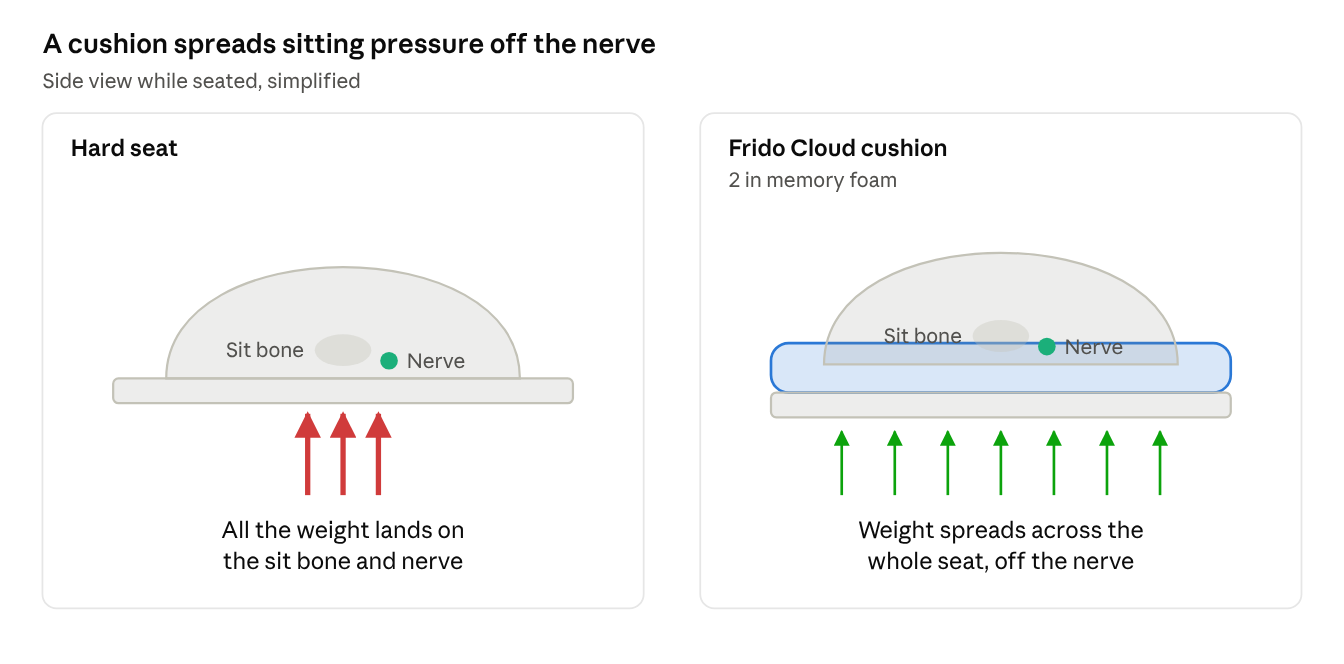
Sitting is the load these patients cannot avoid: often 6–10 hours a day at a desk, in a car or on transport. On a hard seat the body weight concentrates on a small contact area under the ischial tuberosities, right beside the sciatic nerve in the deep gluteal space. Hours of that sustained compression keep the tissue irritable between sessions.
Viscoelastic memory foam lets the pelvis sink in, increasing the contact area and lowering peak interface pressure: the same principle of pressure redistribution used in seating for pressure-injury prevention. For this patient it means less compression over the piriformis and nerve through the day, which supports what you do in the clinic.
Evidence, honestly: the rationale is mechanical. No trial has tested Frido cushions, or seat cushions in general, as a treatment for piriformis syndrome. Recommend one as an adjunct to load management when sustained sitting is a clear aggravating factor in your findings, not on its own.
Choosing the cushion
Default: the Frido Cloud Seat Cushion. It has the thickest memory foam (2 in), the widest pressure spread and a sloped front edge that offloads the posterior thigh along the nerve's course. Put it on the chair the patient sits on longest.
| Patient profile | Recommend |
|---|---|
| Desk worker or driver sitting 4+ hours a day | Cloud on the main chair |
| Fixed-height desk, short stature with feet losing floor contact, low-roof car | Slim: less lift, same geometry |
| Daily commute, frequent flights or train travel | Cloud at the desk, plus Portable for travel |
| Coccydynia or ischial bursitis is the main problem | None of the three has a coccyx cut-out; these are not the right products |
| DefaultCloud Seat Cushion | Slim Seat Cushion | Portable Travel Seat Cushion | |
|---|---|---|---|
| Price (MRP) | ₹1,899 | ₹1,299 | ₹1,299 |
| Foam | High-density memory foam | Hi-Per memory foam | High-density PU foam, Lycra top |
| Thickness | 2 in (~5 cm) | 30 mm | Not listed |
| Size | 18 × 18 in | 46 × 46 cm | Foldable |
| Shape | Contoured, sloped front edge | Flat | Flat, folds with a handle |
| Weight | Not listed | 380 g | ~360 g |
| Use it on | Office chair, car, home: the chair the patient sits on longest | Fixed-height desks, dining chairs, low-roof cars | Flights, trains, cabs, stadium seats |
| Clinical rationale | Most sink and the largest contact area, so the lowest peak pressure under the ischial tuberosities. The sloped front edge offloads the posterior thigh, along the course of the sciatic nerve. | Good pressure redistribution with less lift, so workstation and pedal geometry barely change. | Takes the edge off hard travel seats so offloading continues away from the main chair. |
| Watch for | Raises the seat about 5 cm: recheck desk height, foot support, and for drivers pedal reach and headroom. | Less sink than the Cloud; no thigh offloading edge. | Firmer PU foam spreads load less than memory foam: an add-on, not the main cushion. |
Prices as listed on myfrido.com on 14 Oct 2026; check the product page for today's price.
Setting it up with the patient
- Sit fully back so the pelvis is on the cushion, not perched on the front edge. On the Cloud, the sloped edge faces forward.
- Recheck after adding it: hips level with or slightly above the knees, feet flat (add a footrest if needed), elbows at desk height, screen at eye level.
- Drivers: recheck pedal reach, headroom and mirrors before driving.
- The cushion does not replace breaks: keep standing every 30–45 minutes.
In the Frido Care app, add a cushion to the plan only when your findings show sitting load is a driver; you accept, edit or drop every suggestion. Frido ships it to the patient directly, or they collect it at a Frido store.
Talking to the patient
Explain it in plain words
"Your pain isn't coming from your spine. There's a small muscle deep in your buttock, and the main nerve to your leg runs right beside it. When the muscle gets tight, it squeezes the nerve, and you feel it down the leg. Sitting for hours presses on that spot, so we'll take the pressure off while we loosen and strengthen the muscle."
What to say about the cushion, and what not to
| Say | Don't say |
|---|---|
| "It spreads your weight so there is less pressure on the muscle and nerve while you sit." | "It treats sciatica" or "it will cure the pain" |
| "It works alongside your exercises and breaks." | "You won't need the exercises with this" |
Frido does not claim any of these cushions treats sciatica or piriformis syndrome. None has a tailbone cut-out.
Exercise demos to send
Every exercise in the plan above, with a short demonstration video and written steps. Send the ones you prescribe, with your own dose.
| Exercise | Phase | Starting dose | Demo |
|---|---|---|---|
| Supine figure-4 piriformis stretch | 1 | 3 × 30 s, 2–3 times a day | Watch (demo video, opens in a new tab) |
| Sciatic nerve slider (slump sitting, head lifts as the knee straightens) | 1–2 | 10–15 smooth reps, short of symptoms | Watch (demo video, opens in a new tab) |
| Cross-body piriformis stretch, supine | 2 | 3 × 30 s, 2–3 times a day | Watch (demo video, opens in a new tab) |
| Seated figure-4 piriformis stretch | 2 | 3 × 30 s; useful at the desk | Watch (demo video, opens in a new tab) |
| Sciatic nerve tensioner (slump sitting, chin down, knee straightens) | 2 | 5–10 reps, only once sliders are symptom-free | Watch (demo video, opens in a new tab) |
| Clamshell | 2 | 2–3 × 10–15, 3 times a week | Watch (demo video, opens in a new tab) |
| Side-lying hip abduction | 2 | 2–3 × 10–15, 3 times a week | Watch (demo video, opens in a new tab) |
| Glute bridge | 2 | 2–3 × 10–15, 3 times a week | Watch (demo video, opens in a new tab) |
| Side plank on knees | 2–3 | 3 × 15–30 s hold, progress to full side plank | Watch (demo video, opens in a new tab) |
Demonstrations: Physitrack home exercise videos.
Send the patient view
The patient view of this protocol has the explainer, the home plan from Phase 1 and the safety-net in plain words, and leaves out everything clinical. Send it with Send patient view at the top of this page, or switch to it with the toggle to go through it together in the session.
Sources
- Piriformis Syndrome, Hicks BL, Lam JC, Varacallo M. StatPearls, NCBI Bookshelf (updated Aug 2023)
- Pyriformis syndrome: Myth or reality?, Neurology Asia, 2023
- Variations of the piriformis and sciatic nerve with clinical consequence: a review, Smoll NR. Clinical Anatomy, 2010; 23(1): 8–17 (meta-analysis)
- Piriformis syndrome: diagnosis, treatment, and outcome, a 10-year study, Fishman LM et al. Archives of Physical Medicine and Rehabilitation, 2002; 83(3): 295–301
- Diagnostic accuracy of clinical tests for sciatic nerve entrapment in the gluteal region, Martin HD et al. Knee Surgery, Sports Traumatology, Arthroscopy, 2014; 22(4): 882–888 (n = 33, endoscopy as reference)
- Deep gluteal syndrome: anatomy, imaging, and management of sciatic nerve entrapments in the subgluteal space, Hernando MF et al. Skeletal Radiology, 2015; 44(7): 919–934
- Exercise demonstrations, Physitrack home exercise videos
- Frido Cloud Seat Cushion, myfrido.com
- Frido Slim Seat Cushion, myfrido.com
- Frido Portable Travel Seat Cushion, myfrido.com

For physiotherapists and doctors
Use these guides with your patients
Every guide has a plain-language patient view and a printable home guide to share after a session. Certifications & Training, leading to Frido Verified Partner, is coming soon.