
Clinical protocol Back & neck
Cervical spondylosis: neck pain, stiffness and the pillow
Cervical spondylosis, often loosely called "spondylitis", is age-related wear in the neck's discs and joints, present in more than 85% of people over 60. It brings neck pain, stiffness and headaches that come and go, and every night the pillow sets the neck's angle for hours. The mechanism, the Neck Disability Index, the spondylitis mix-up, the treatment routes and what a pillow can and can't do.
Filed underCervical spondylosisNeck
Patient explainer
A 1:43 explainer with every key point on screen. Play it in the session, or send the patient view: the same video with a neck score, five exercises and the nightly set-up, and nothing clinical.
Clinical summary
- What it is
- Age-related wear: discs dry and lose height, the facet joints take more load, and spurs can narrow the space for nerve roots and the cord. Many people with the changes feel nothing.
- How common
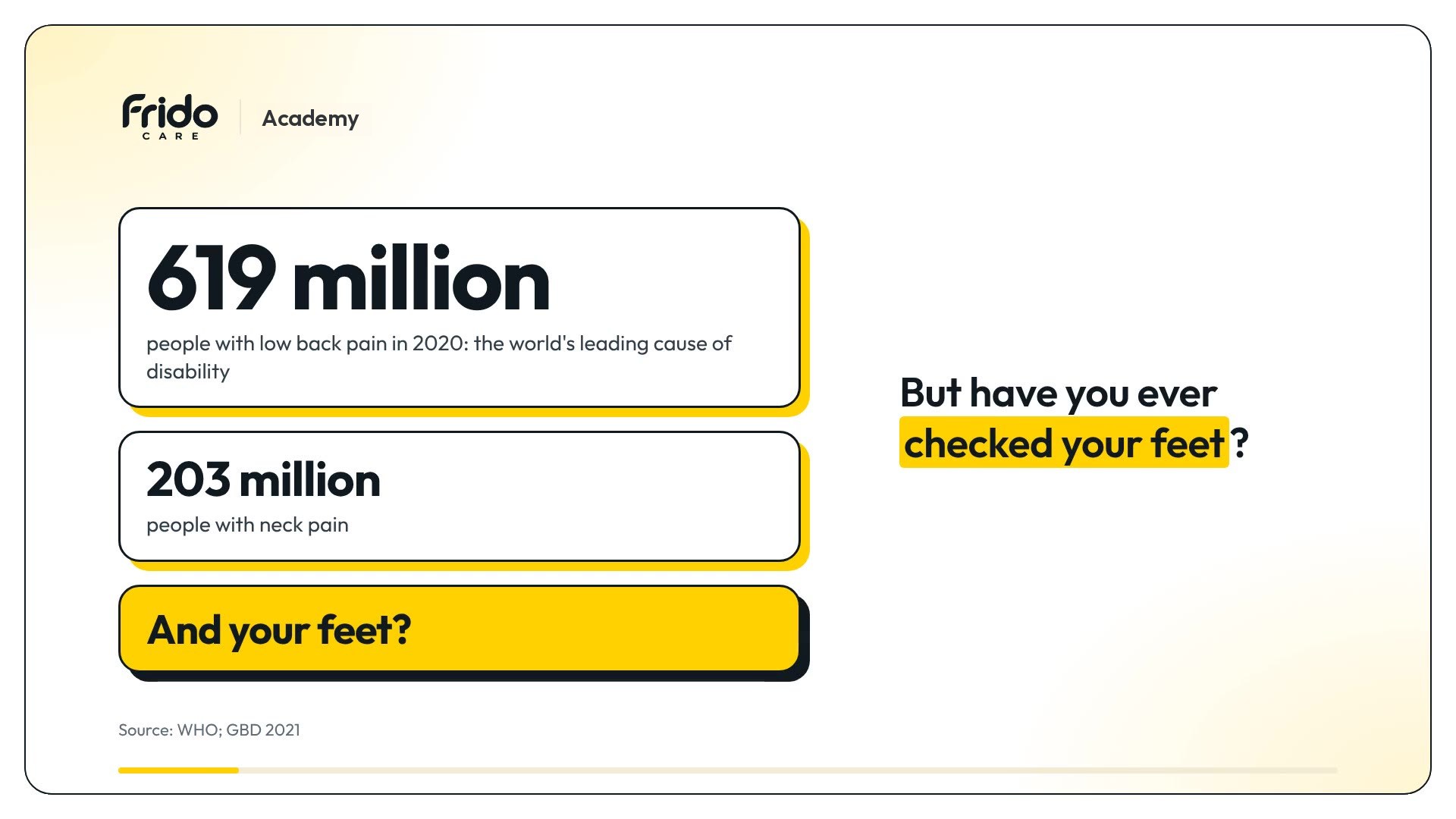
- More than 85% of people over 60; neck pain affected 203 million people in 2020, and 50–75% have it again within 1 to 5 years.
- Assess
- Neck Disability Index (out of 50; a 5-point change is real), reflexes and gait, and how and on what the patient sleeps. Image only for nerve or cord signs.
- First line
- Keep moving, simple painkillers, strengthening of the neck, shoulders and upper back (moderate-quality evidence), and one low, firm pillow matched to the sleep position.
- Don't
- Weeks in a soft collar, stacked pillows, keeping the neck still, or sleeping on the front.
- Refer
- 999 for new walking problems, bladder or bowel change or sudden loss of co-ordination; urgent GP for arm or leg heaviness or weakness, pins and needles with neck or arm pain, or pain between the shoulder blades.
Sleep set-up
Frido Ultra Slim Deep Sleep Pillow ₹1,499 ₹3,299
Ultimate Cervical Pillow for side sleepers.
Sets a lower, level neck angle for back sleepers. It doesn't touch the wear itself, and no study has tested this pillow.
The plan in three stages
1Relieve
Settle the flare, in the first 2 weeks.
- Keep your neck moving gently; don't hold it still.
- Painkillers if needed, such as paracetamol or ibuprofen, as your doctor or pharmacist advises.
- No soft collar for weeks: it can weaken your neck muscles.
- Heat and massage give short-term comfort at most.
More on this: Fixing it: the optionsAssessment, referral and plan
2Restore
Keep the neck level, day and night.
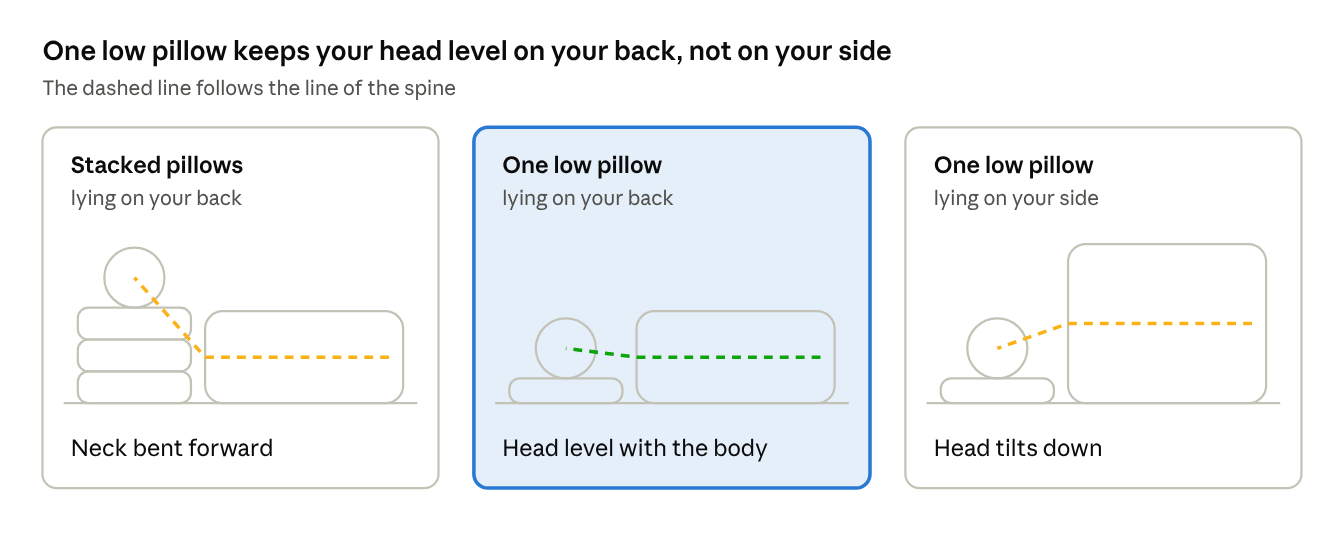
- One low, firm pillow that keeps your head level with your body. Side sleepers need a taller one.
- Don't stack pillows, and don't sleep on your front.
- Take breaks from looking down at a screen.
More on this: Where a low pillow fitsTalking to the patient
3Reinforce
Strengthen the neck, shoulders and upper back, from week 2.
- Every day: chin tucks (demo video, opens in a new tab), isometric holds (demo video, opens in a new tab) and shoulder rolls (demo video, opens in a new tab), only to a stretch, never into strong pain.
- Score your neck again after two weeks: 5 points lower is a real change.
- Keep the habits when it settles, because it often comes back.
- See a doctor urgently for weakness, or pins and needles with neck or arm pain.
More on this: Exercises and routines that helpScore the neck before blaming the pillow
What cervical spondylosis is
With age, the discs between the neck bones dry out, weaken and lose height, and the facet joints behind them wear the way a knee does (AAOS OrthoInfo). The body adds bony spurs, which can narrow the space for the nerve roots and spinal cord, and the cervical curve flattens as load shifts onto the joints (AAOS OrthoInfo; Physiopedia). Many people have these changes and feel nothing (NHS).
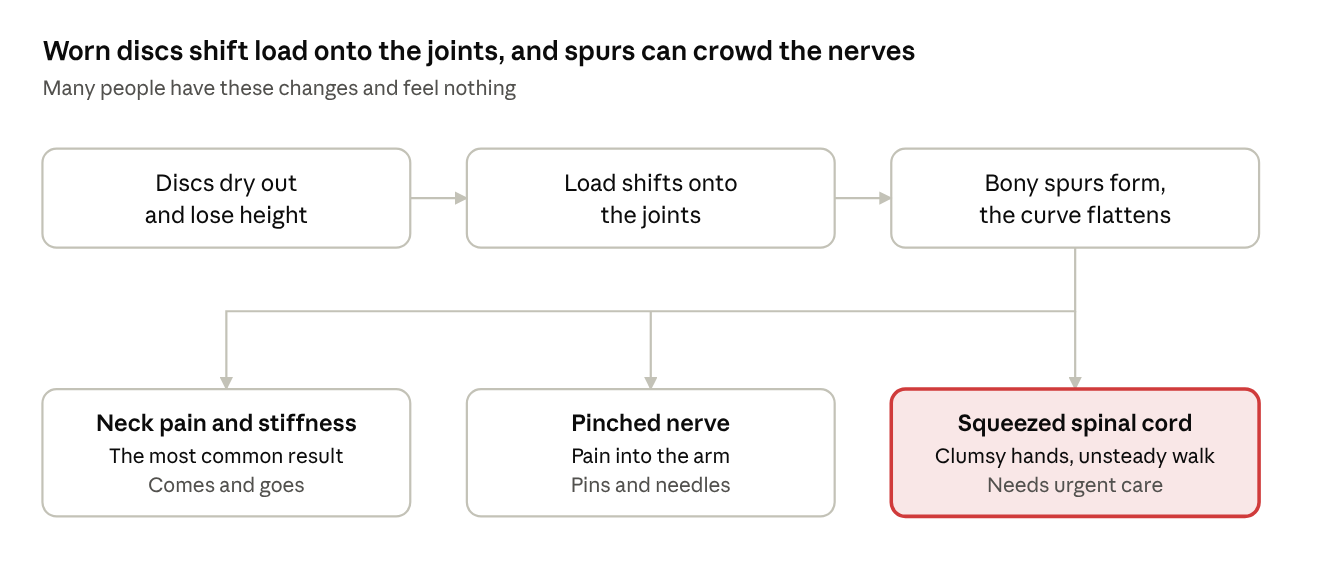
Typical signs: neck and shoulder pain or stiffness that comes and goes, and headaches that start at the back of the neck (NHS).
How it affects the patient
It tends to return: 50% to 75% of people have neck pain again within 1 to 5 years (Physiopedia, on Carroll 2008). In 100 patients at a Kerala hospital, cases peaked at ages 40 to 49 and men outnumbered women (Bist 2018). Spurs on a nerve root send pain and pins and needles into the arm; pressure on the cord can make the hands clumsy and the gait unsteady (Physiopedia).
Score the neck before blaming the pillow
The Neck Disability Index scores 10 daily tasks from 0 (no trouble) to 5 (can't do it), for a total out of 50 (Physiopedia).
| Task | Score (0–5) | Task | Score (0–5) |
|---|---|---|---|
| Pain intensity | Headaches | ||
| Personal care | Concentration | ||
| Lifting | Work | ||
| Reading | Driving | ||
| Sleeping | Recreation |
Bands: 0–4 none, 5–14 mild, 15–24 moderate, 25–34 severe, 35–50 complete (Physiopedia, on MacDermid 2009). Re-score after two weeks; a drop of 5 points or more is more than measurement noise (Physiopedia).
Why it happens
Age drives the wear; the other rows speed it up or make it hurt more (AAOS OrthoInfo).
| Cause | What it does | The clue |
|---|---|---|
| Ageing discs and joints | Discs flatten; the joints take more load | Over 40, with stiffness that comes and goes (NHS) |
| Past neck injury or family history | Raises the risk at any age | An old whiplash or fall, or parents with neck trouble (NHS) |
| Repetitive neck work | Loads the neck joints | A job spent looking up, down or turning (AAOS OrthoInfo) |
| Smoking | Clearly linked to more neck pain | The patient smokes (AAOS OrthoInfo) |
| Pillow at the wrong height | Sets the neck's angle for the whole night | Pain and stiffness worst on waking (Pang 2021) |
How it's diagnosed
Examine the neck and shoulders, check reflexes and watch the patient walk; X-rays or scans only if the symptoms call for them (NHS). A scan alone can't settle it: nearly half of middle-aged and older adults have worn discs that cause no pain (AAOS OrthoInfo).
| Often called | What it might be | What points to it |
|---|---|---|
| "Spondylitis" after 40 | Cervical spondylosis | Neck pain or stiffness that comes and goes, and headaches from the back of the neck (NHS) |
| "Spondylitis" in a teen or young adult | Ankylosing spondylitis, an inflammatory disease | Back pain and stiffness building over months, swollen joints and extreme tiredness (NHS) |
| "A pinched nerve" | Pressure on a nerve root or the cord | Pins and needles or weakness in an arm, clumsy hands or an unsteady gait (NHS; Physiopedia) |
Fixing it: the options
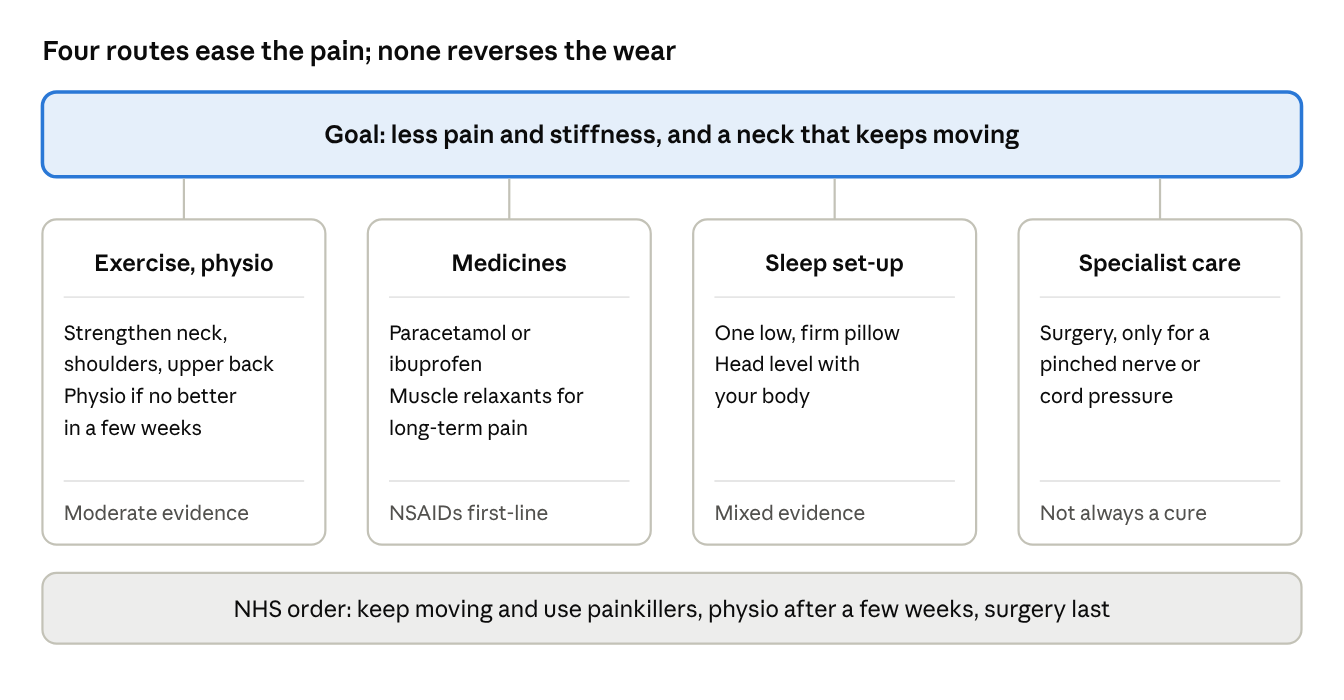
The wear won't reverse, but treatment usually settles the pain within a few weeks, and it can return (NHS). Three quick fixes backfire:
- A soft collar worn for weeks: long-term use may weaken the neck muscles (AAOS OrthoInfo; UH Sussex NHS).
- Stacking pillows: avoid more than two; the NHS advises one low, firm pillow (UH Sussex NHS; NHS).
- Keeping the neck still: keep it moving unless a doctor says otherwise (NHS).
| Route | Options | What the evidence shows |
|---|---|---|
| Exercise and physio | Neck, shoulder and upper-back strengthening | A moderate to large drop in chronic neck pain (moderate-quality evidence); stretching alone may not help (Cochrane, Gross 2015) |
| Medicines | Paracetamol or ibuprofen; muscle relaxants for long-term pain | NSAIDs are first-line for neck pain (AAOS OrthoInfo; NHS) |
| Heat, massage, traction | Short-term comfort | Not enough evidence in neck pain (Physiopedia, on the Philadelphia Panel) |
| Sleep set-up | One low, firm pillow that keeps the head level | Some pillow designs cut waking pain and disability in chronic neck pain (Pang 2021); in a pilot trial in spondylosis, no pillow changed any outcome (Gordon 2019) |
| Injections and surgery | For nerve root or cord pressure | Surgery may stop symptoms getting worse, but isn't always a cure (NHS) |
NHS order: movement and painkillers first, physio after a few weeks, surgery only for nerve or cord pressure (NHS).
Where a low pillow fits
It belongs to the sleep set-up route. The Frido Ultra Slim Deep Sleep Pillow is a flat, 50.6 mm gel memory foam pillow sold for back and stomach sleepers (product page). On the back, a pillow this low keeps the head close to level with the body, as the NHS advice on one low, firm pillow intends (NHS).
| DefaultUltra Slim Deep Sleep Pillow | Ultimate Cervical Pillow | |
|---|---|---|
| Price (MRP) | ₹1,499 | ₹1,199 |
| Build | 100% gel memory foam, flat, bamboo-infused cover | Memory foam, contoured, two usable sides |
| Height | 50.6 mm, not adjustable | 125 mm, with a lower second side |
| Sleep position | Back and stomach | Back, side and combination |
| Rating | 4.9/5 (7 reviews) | Not listed |
Prices as listed on myfrido.com on 16 Oct 2026; check the product page for today's price.
What it doesn't do: it can't reverse disc wear or free a pinched nerve, it isn't made for side sleeping, and the NHS advises against sleeping on the front with neck pain (NHS).
Does it solve the main problem?
It can set a better neck angle for back sleepers, but it doesn't touch the wear itself, and no study has tested this pillow.
| Part of the problem | Solved? | Why |
|---|---|---|
| Disc and joint wear | No | Age-related wear doesn't reverse (AAOS OrthoInfo) |
| Neck angle when sleeping on the back | Yes | A low, firm pillow keeps the head level, as the NHS advises (NHS) |
| Waking pain and stiffness | Partly | Some pillows cut waking pain in neck pain (Pang 2021); none helped in a spondylosis pilot trial (Gordon 2019) |
| Neck angle when sleeping on the side | No | Sold for back and stomach sleepers (product page) |
| A pinched nerve or cord pressure | No | Needs a clinician's assessment (NHS) |
Can say: a low, 50.6 mm gel memory foam pillow for back sleepers, in line with the NHS advice on one low, firm pillow. Can't say: treats or cures spondylitis or spondylosis, eliminates morning neck pain, prevents headaches or migraines, or "clinically proven".
Which pillow to choose
Back sleepers: the Ultra Slim, if the head sits level on a low pillow. Side sleepers: the taller, contoured Ultimate Cervical Pillow. Make it work: one pillow only, someone checks that the head lines up with the body, 7 to 14 nights to settle in (product page), then re-score the NDI.
In the Frido Care app, add a pillow to the plan only when your findings call for one; you accept, edit or drop every suggestion.
Assessment, referral and plan
Assess: the Neck Disability Index, reflexes and gait, and how and on what the patient sleeps (NHS; Physiopedia).
SettleWeeks 0–2
- Keep moving, painkillers if needed, one low pillow matched to the sleep position (NHS).
RestoreWeeks 2–6
- Neck, shoulder and upper-back strengthening: chin tucks (demo video, opens in a new tab), isometric holds (demo video, opens in a new tab), shoulder rolls (demo video, opens in a new tab); physio if it isn't improving (Cochrane, Gross 2015; NHS).
ReviewWeek 6 on
- Re-score the NDI; image or refer only for nerve or cord signs (NHS).
Talking to the patient
Explain it in plain words
"Your neck has some wear, like most people your age. A pillow can't undo that, but the right height stops your neck sitting bent all night, and the exercises keep it moving."
Their nightly set-up
One low, firm pillow with the head level with the body. No stacked pillows, no soft collar to bed, and not on the front (NHS; UH Sussex NHS).
Send the patient view
The patient view has the explainer, the neck score, the five exercises, the nightly set-up and the safety-net in plain words, and leaves out everything clinical. Send it with Send to patient at the top of this page.
Exercises and routines that help
| Exercise | How much | Demo | How-to |
|---|---|---|---|
| Chin tuck (chin straight back) | Hold 5–10 seconds | Watch (demo video, opens in a new tab) | CHT NHS: neck strength and stability |
| Side bend (ear to shoulder) | Hold 5 seconds, 5 each side | Watch (demo video, opens in a new tab) | Royal Wolverhampton NHS: neck exercises |
| Head turn (look over each shoulder) | Hold 5 seconds, 5 each side | Watch (demo video, opens in a new tab) | Royal Wolverhampton NHS: neck exercises |
| Isometric holds (push into your hand without moving) | Hold 5–10 seconds | Watch (demo video, opens in a new tab) | CHT NHS: neck strength and stability |
| Shoulder rolls | Both directions, 5 times | Watch (demo video, opens in a new tab) | Royal Wolverhampton NHS: neck exercises |
Strengthening the neck, shoulders and upper back has the best evidence, while stretching alone may not help (Cochrane, Gross 2015). Move only until you feel a stretch, never into severe pain (Royal Wolverhampton NHS).
Sources
- Cervical spondylosis (arthritis of the neck), AAOS OrthoInfo
- Cervical spondylosis, NHS
- Neck pain, NHS
- Ankylosing spondylitis, NHS
- Cervical spondylosis, Physiopedia
- Neck Disability Index, Physiopedia
- GBD 2021 neck pain study (Lancet Rheumatology 2024), Kolling Institute
- Cervical spondylosis: analysis of clinical and radiological correlation, Bist PKR et al. International Surgery Journal, 2018
- The effects of pillow designs on neck pain, waking symptoms, neck disability, sleep quality and spinal alignment in adults: a systematic review and meta-analysis, Clinical Biomechanics, 2021 (PolyU research page)
- Pillow preferences of people with neck pain and known spinal degeneration: a pilot randomised controlled trial, Gordon SJ et al. European Journal of Physical and Rehabilitation Medicine, 2019 (PEDro record)
- Exercises for mechanical neck disorders, Gross A et al. Cochrane Database of Systematic Reviews, 2015
- Self-treatment of acute neck pain, University Hospitals Sussex NHS, 2025
- Video exercises for neck pain, Chartered Society of Physiotherapy
- Neck pain exercise videos, Patient.info
- Neck strength and stability exercises, Calderdale and Huddersfield NHS
- Neck exercises, Royal Wolverhampton NHS
- Product pages: Ultra Slim Deep Sleep Pillow, Ultimate Cervical Pillow, myfrido.com, 16 Oct 2026
For physiotherapists and doctors
Use these guides with your patients
Every guide has a plain-language patient view and a printable home guide to share after a session. Certifications & Training, leading to Frido Verified Partner, is coming soon.