
Clinical protocol Nose & breathing
Is your nose the weak link in your workout? (nasal obstruction)
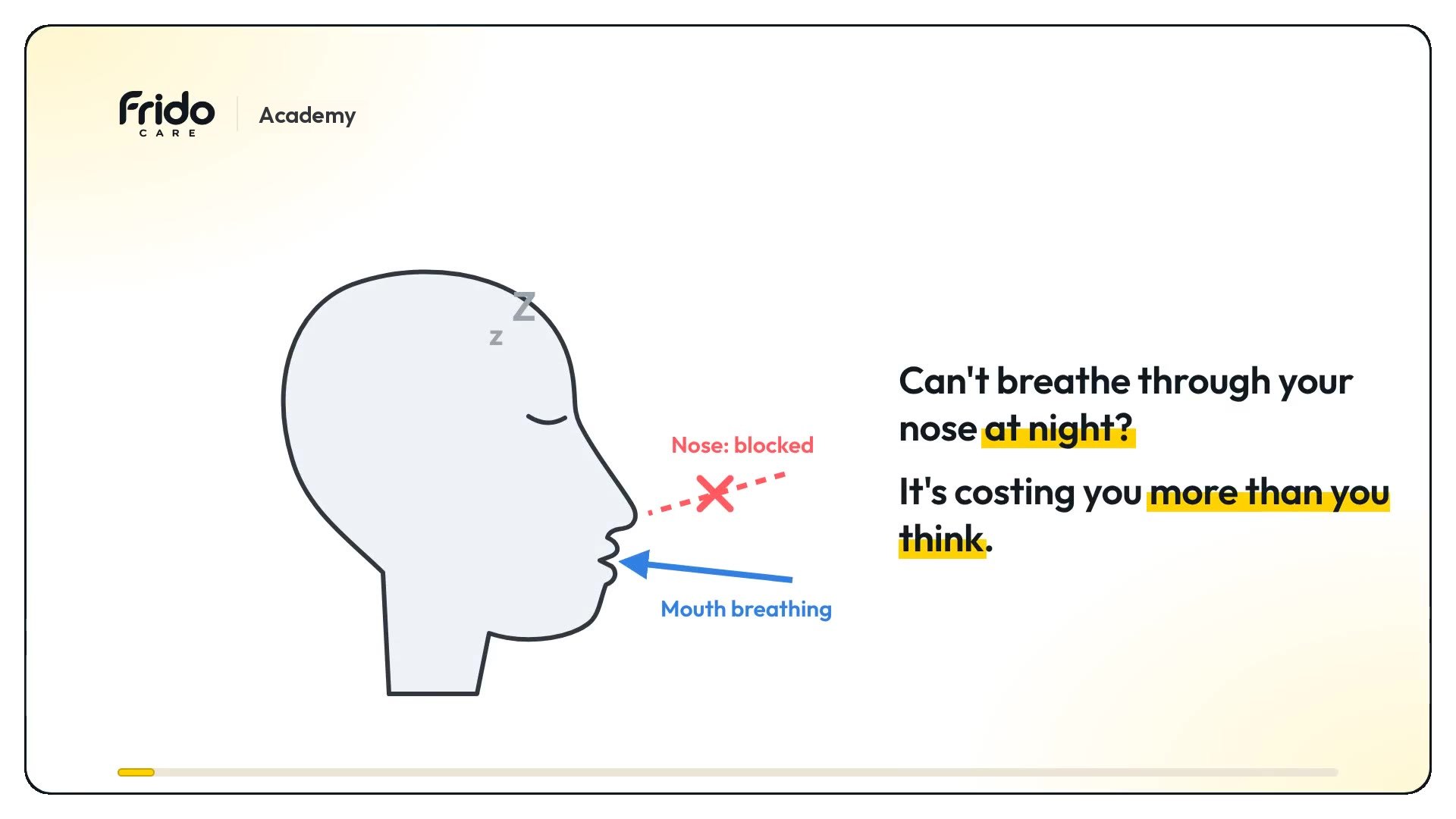
Nasal symptoms affect 70% of athletes against 52% of non-athletes. A nose that gives out before the legs do switches the patient to mouth breathing, and the airways, sleep and recovery pay for it. How exercise loads the nasal valve, three quick checks, the causes, and the timing of each fix.
Filed underExercise-induced nasal obstructionNose
Patient explainer
A 1:47 explainer with every key point on screen. Play it in the session, or send the patient view: the same video with three self-checks, a breathe-along exercise and the pre-workout routine, and nothing clinical.
Clinical summary
- What it is
- Exercise shrinks the nasal lining (resistance falls by about half), but faster airflow drops the pressure at the nasal valve and draws a soft lateral wall inward. If the walls give way, the patient switches to mouth breathing at an easy pace.
- How common
- Nasal symptoms in 70% of athletes against 52% of non-athletes; rhinitis in 21–74% of athletes against 20–25%; non-allergic rhinitis in 45% of elite swimmers.
- What it costs
- Not peak aerobic performance (unchanged with the nose clipped), but unfiltered, cold, dry air, more exercise-induced airway narrowing in those prone to it, and worse sleep and recovery.
- Assess
- Training history, the lateral walls on a hard sniff, the cheek pull, and nasal airflow with and without a dilator. A 0–10 weekly rating of 5 or more means act; still 5 or more after 7 days of treatment means refer.
- First line
- Timing: warm up close to the start, hold the walls open during, rinse and treat the lining every day, fix the frame in the off-season. Decongestants for 5 days at most; check pseudoephedrine before competition.
- Refer
- Urgently for a swelling inside the nose after a knock (septal haematoma); set a broken nose within 7 days. Cough, wheeze or chest tightness with exercise points to the chest.
Training adjunct
Frido Nasal Strip Pro ₹499 ₹1,000
Nasal Strips for rest days, travel or a cold, when it shouldn't show.
Holds the side walls open on hard breaths while worn. It won't treat the lining or make anyone fitter or faster.
The plan in three stages
1Relieve
Breathe through your nose in this session.
- Warm up close to the start: the opening effect fades within 20 minutes of stopping. Watch a warm-up (demo video, opens in a new tab)
- If the cheek pull helped, wear a nasal strip. If you sweat a lot, put it on 30 minutes before.
- Rinse with saltwater if you're stuffy. Watch how (demo video, opens in a new tab)
More on this: Fixing it: before, during and after a workoutWhere the Frido Nasal Strip Pro fits
2Restore
Keep the nose working, session after session.
- Every day: a saltwater rinse, and a spray if your doctor gives you one.
- No decongestant spray for more than 5 days, and check cold tablets with a pharmacist before a race.
- Keep your mouth closed on the easy parts of every session.
More on this: Why it happensTalking to the patient
3Reinforce
Train your nose breathing and check your progress.
- A few minutes of calm nose breathing a day: in over 2 steps, out over 4. Watch how (demo video, opens in a new tab)
- Redo the two-minute checks after two weeks of the plan.
- If the shape inside your nose is the cause, a specialist may suggest surgery in the off-season.
- See a doctor if you cough or wheeze when you exercise, or nothing has changed after 6 weeks.
More on this: Is the nose the weak link? Three checks, two minutesExercises and routines that help
What happens to the nose during exercise
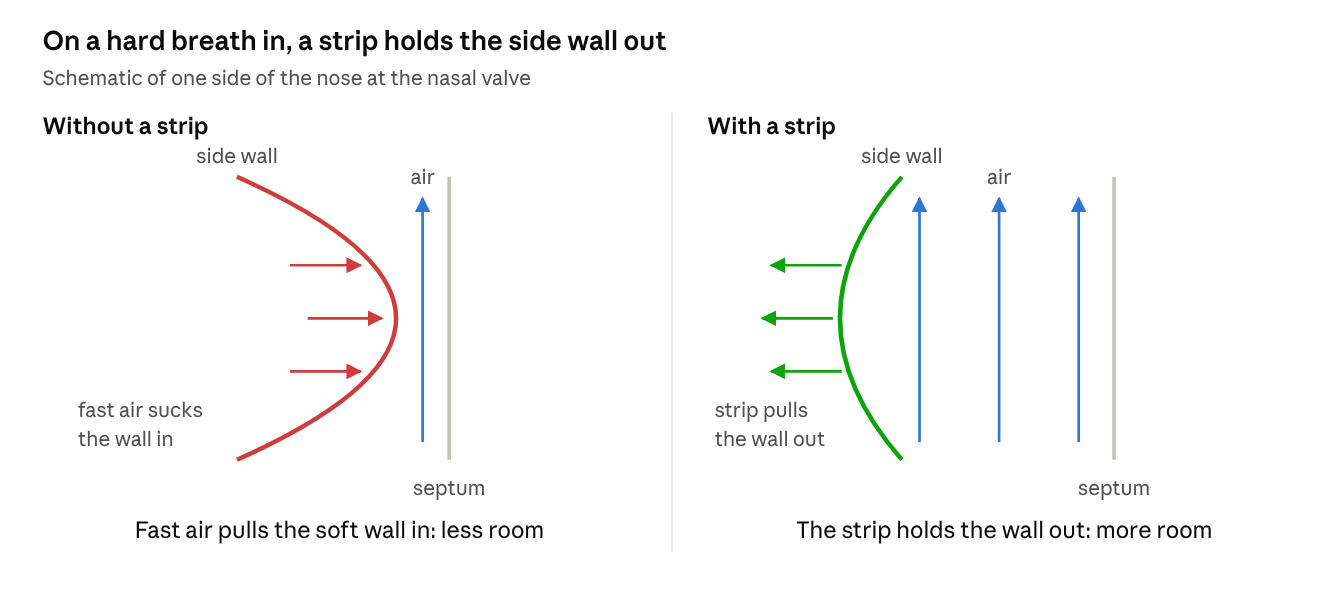
Exercise opens one part of the nose and squeezes another. The lining shrinks, cutting nasal resistance by about half after hard exercise (Strohl 1988). But faster air drops the pressure at the nasal valve, the narrow slit just inside the nostrils, and sucks its soft side walls inward (McIntosh 2021; Bloching 2008).
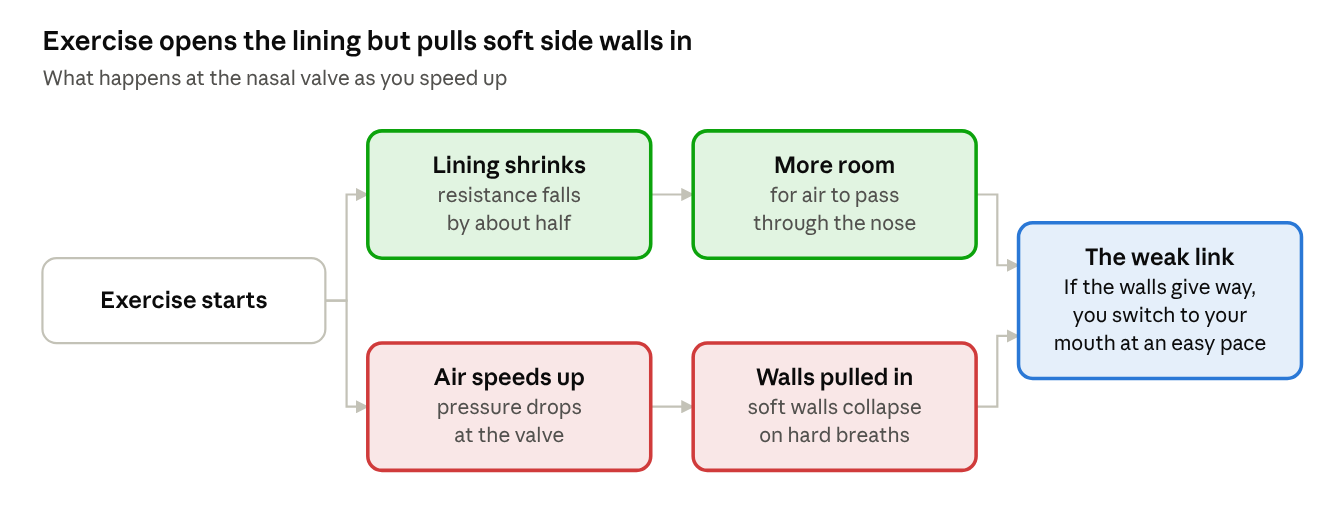
Most people breathe through the nose alone up to a moderate effort, about 35 litres of air a minute, then add the mouth, which is normal at hard efforts (Bergqvist 2025, citing Niinimaa 1980; McIntosh 2021).
Typical signs: the mouth opens at an easy pace, the nostrils cave in on a hard breath, and the nose runs or blocks with training, cold air or a swim (McIntosh 2021).
What a weak nose costs
It won't cap top speed: with the nose clipped shut, maximum aerobic performance didn't drop (McIntosh 2021). What it costs is everything around the workout:
- Air that skips the filter. The nose heats, moistens and filters air; a mouth breath skips all three (McIntosh 2021).
- Tighter airways. Nose breathing markedly reduced exercise-induced airway narrowing in some studies, which matters most for patients prone to exercise asthma (McIntosh 2021; Dallam 2020).
- Sleep and recovery. A blocked nose drags down sleep, mood and quality of life, with knock-on effects on health and performance (McIntosh 2021). It follows the patient to bed too: see the companion protocol, Blocked nose at night.
- Higher odds in people who train. Rhinitis affects 21–74% of athletes against 20–25% of everyone else, and 45% of elite swimmers have the non-allergic kind (McIntosh 2021).
Is the nose the weak link? Three checks, two minutes
| Check | How to do it | What it tells you |
|---|---|---|
| 1. The warm-up test | Mouth closed through an easy 5-minute warm-up | Most people manage nose-only breathing at a moderate effort (Dallam 2020); needing the mouth at an easy pace marks the weak link |
| 2. The cheek pull | Breathe in through the nose, then again while gently pulling one cheek outward | Easier with the pull: the side walls are caving in. No change: a fixed narrowing or a swollen lining (McIntosh 2021) |
| 3. The 0–10 rating | Rate from 0 to 10 how much the nose bothered training this week | 5 or more: act on it. Still 5 or more after 7 days of treatment: refer (McIntosh 2021) |
Repeat all three after two weeks. The patient view carries the same checks in plain words.
Why it happens
Two things narrow the nose in training: a lining that swells or runs, and a frame that is bent or floppy (McIntosh 2021, the source for every row).
| Cause | What it does | The clue |
|---|---|---|
| Allergy (pollen; more common in outdoor sport) | Swells the lining | Itching and sneezing, worse in pollen season |
| Exercise, cold air, pollution or chlorine | A runny or blocked nose without an allergy | Starts with the session or the swim |
| A decongestant spray used for more than 5 days | Rebound swelling | Worse each time it wears off |
| A past knock (contact sport) | A bent septum or spur: a fixed narrowing | One side always worse; the cheek pull doesn't help |
| Weak side walls (past injury or surgery) | Sucked in on hard breaths | The cheek pull helps |
How it's diagnosed
A sports doctor or ENT starts with a symptom score, the training history and the cheek-pull test, then adds tests only if needed: a camera exam, nasal airflow with and without a dilator, or allergy tests (McIntosh 2021).
| Often called | What it might be | What points to it |
|---|---|---|
| "I'm just unfit" | A nose that can't keep up | Mouth breathing at an easy pace while the legs feel fresh; the cheek pull helps (Dallam 2020; McIntosh 2021) |
| "Exercise asthma" | The chest, the nose, or both | Cough, wheeze or chest tightness during or just after exercise points to the chest: refer to a doctor (National Jewish Health) |
| "Swimmer's nose" or "runner's nose" | Non-allergic rhinitis | A drip or block that starts in the pool or in cold air, without itching or sneezing (McIntosh 2021) |
Fixing it: before, during and after a workout
Left alone, a floppy valve only shuts harder as the athlete pushes (McIntosh 2021). Three quick fixes backfire:
- A decongestant spray before every session: after 5 days it causes rebound swelling (McIntosh 2021).
- Cold and flu tablets on race day: pseudoephedrine is banned in competition above 150 micrograms per millilitre of urine; stop it at least 24 hours before (Sport Integrity Australia).
- Warming up too early: the opening effect fades within 20 minutes of stopping (Fonseca 2006).
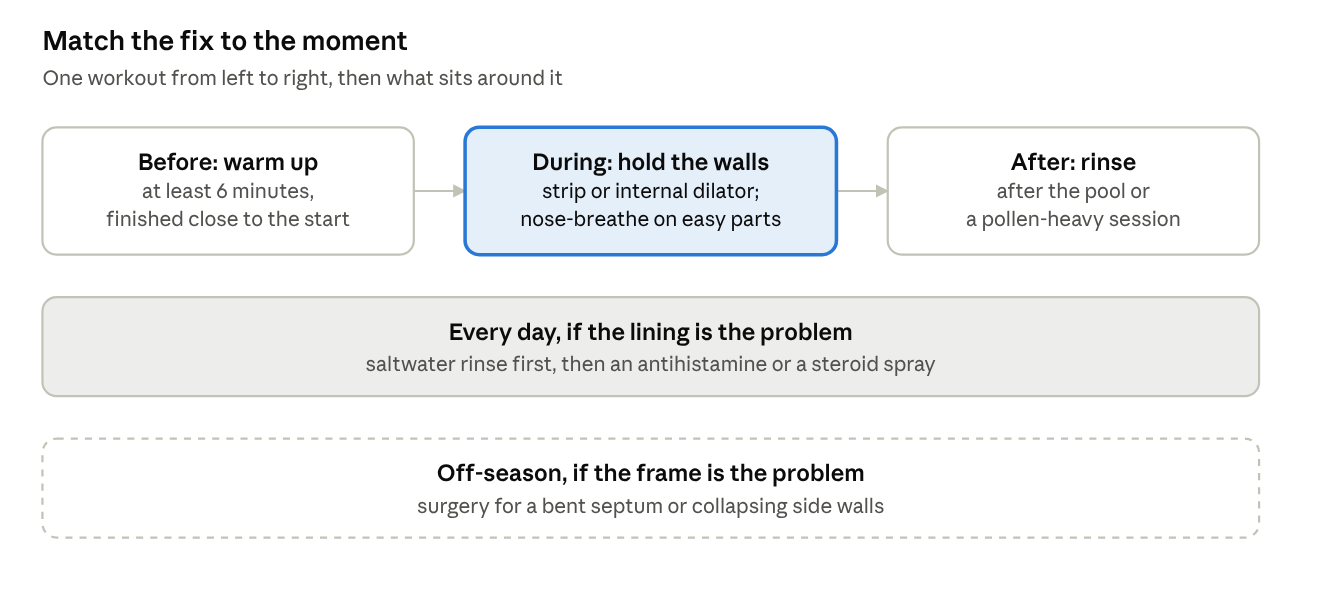
| When | What the evidence shows |
|---|---|
| Before | 5 minutes of easy cycling raised nasal volume by a third (Fonseca 2006); a warm-up (demo video, opens in a new tab) that ends close to the start |
| During | Dilators give temporary relief for collapsing walls (McIntosh 2021) and may allow nose breathing at a higher work rate (Dallam 2020) |
| Every day | A saltwater rinse (demo video, opens in a new tab) comes first for allergic and non-allergic rhinitis, then antihistamines or steroid sprays (McIntosh 2021) |
| Off-season | Surgery is the only permanent fix for a bent septum or collapsing walls (McIntosh 2021) |
Where the Frido Nasal Strip Pro fits
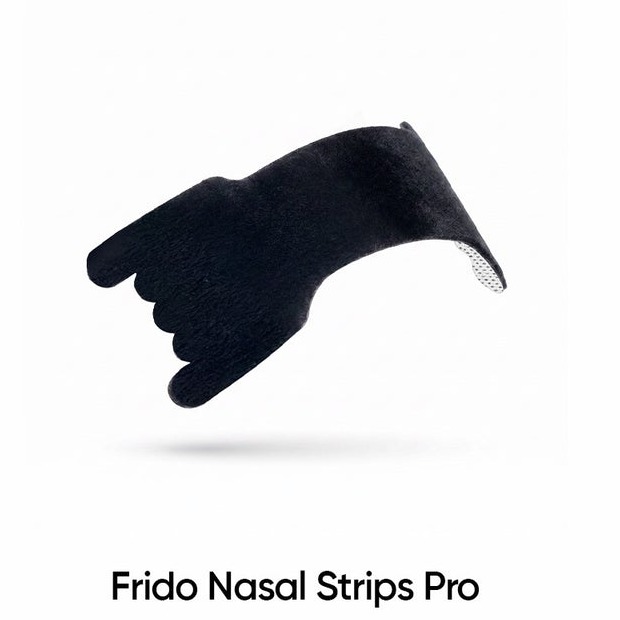
Frido's option sits in the "during" slot. A strip works like a spring, lifting the side walls so they resist the suction of a hard breath (Bloching 2008); in one study it raised airflow through the valve by 21% and cut resistance by 27% (Dinardi 2014). Frido sells the Pro for "sports workouts and active movement" as well as overnight (Frido).
| DefaultNasal Strip Pro | Nasal Strips | |
|---|---|---|
| Price for 15 (MRP) | ₹499 | ₹399 |
| Grip | Sweat- and oil-resistant | Up to 12 hours; apply 30 minutes before heavy sweating |
| Look | Black breathable fabric | Clear, for discreet wear |
| Rating | 4.7/5 (472 reviews) | 4.6/5 (317 reviews) |
| Best for | Training, running and active use | Rest days, travel or a cold |
Prices as listed on myfrido.com on 15 Oct 2026; check the product page for today's price.
Neither strip treats allergy, chlorine irritation or a bent septum.
Does the strip solve the main problem?
It holds the side walls open on hard breaths, but the most common cause in athletes is a swollen or runny lining, and it won't make anyone fitter or faster (McIntosh 2021).
| Part of the problem | Solved? | Why |
|---|---|---|
| Walls sucked in on hard breaths | Yes, while worn | Holds the walls out (Dinardi 2014) |
| Nose breathing at harder efforts | Possibly | Dilators may allow nose breathing at a higher work rate (Dallam 2020) |
| Swollen or runny lining (allergy, chlorine, cold air) | No | Needs a rinse or a spray (McIntosh 2021) |
| Bent septum after a knock | No | Only surgery changes the frame (McIntosh 2021) |
| Fitness, heart rate and effort | No | No gain in VO2max, heart rate or effort in a meta-analysis of healthy people (Dinardi 2020) |
Can say: holds the front of the nose open during workouts; drug-free; a grip built for sweat; works alongside rinses and sprays. Can't say: improves performance, stamina, VO2max or recovery; treats allergy or rhinitis; "clinically proven". We found no study of Frido's own strips.
Which Frido strip to choose
For training, the Pro. Its sweat- and oil-resistant grip keeps it on through running and active use, and a strip only helps while it stays on (Frido). The clear strip suits rest days, travel or a cold, when the patient would rather it didn't show (Frido).
Make it work: clean, dry skin; 30 minutes before the session for heavy sweaters; one use per strip, wetted before peeling off (Frido Nasal Strips; Frido Nasal Strip Pro). Suggest it when the cheek pull helps.
In the Frido Care app, add a strip to the plan only when your findings call for one; you accept, edit or drop every suggestion. Frido ships it to the patient directly.
Assessment, referral and plan
Assess: training history (sport, triggers, past knocks), the walls on a hard sniff, the cheek pull, and nasal airflow with and without a dilator (McIntosh 2021).
SettleWeeks 0–2
- Stop decongestant overuse; rinse (demo video, opens in a new tab); antihistamine if allergic.
- A strip for training if the cheek pull helps.
RestoreWeeks 2–6
- Steroid spray if rhinitis persists.
- Build easy nose-only sessions (demo video, opens in a new tab); repeat the three checks.
ReviewWeek 6 on
- Refer to ENT if the rating stays at 5 or more after 7 days of treatment, dilators fail or training suffers; plan surgery for the off-season (McIntosh 2021).
Talking to the patient
Explain it in plain words
"Your nose is your workout's air filter. When its lining swells or its soft sides get sucked in, you switch to your mouth before your legs tire. We'll find which it is; each has its own fix."
Their routine before each session
Rinse if stuffy, a strip on clean, dry skin (30 minutes ahead for heavy sweaters), a warm-up close to the start, and the mouth closed on the easy parts (UCLH). No decongestant spray for more than 5 days, and cold tablets checked before a race (Sport Integrity Australia).
Send the patient view
The patient view has the explainer, the three checks, a breathe-along exercise, the routine and the safety-net in plain words, and leaves out everything clinical. Send it with Send to patient at the top of this page.
Exercises and routines that help
| Exercise | How much | Demo | How-to |
|---|---|---|---|
| Warm-up | 6 minutes or more, ending close to the start | Watch (demo video, opens in a new tab) | NHS: How to warm up |
| Nose breathing on easy runs and walks | In over 2 steps, out over 4 | Watch (demo video, opens in a new tab) | UCLH respiratory physiotherapy |
| Saltwater rinse | Twice a day while stuffy; after the pool or pollen | Watch (demo video, opens in a new tab) | West Suffolk NHS: Nasal irrigation |
Most people can learn to nose-breathe at harder efforts with sustained practice, though the research is thin (Dallam 2020).
Breathe along
Guided breathing your patient can follow on screen, from NHS physiotherapy advice (Royal Berkshire NHS, 2025). Play it in the session, or send the patient view, which has the same exercise.
Follow the circle: it grows as you breathe in and shrinks as you breathe out. Breathe through your nose, mouth closed, shoulders relaxed.
Ready
- Breathing control
Lie or sit back, one hand on your stomach. Breathe in gently through your nose and feel your stomach rise; breathe out through your nose, longer than the in-breath, and pause.
Breathe in 2 s→Breathe out 3 s→Pause 1 s
Source: Royal Berkshire NHS, 2025
- Short breath holds
Breathe gently through your nose, then stop and hold for a count of 2 or 3. Only as long as it doesn't make you take a bigger breath afterwards.
Breathe in 2 s→Breathe out 3 s→Hold 3 s
Source: Royal Berkshire NHS, 2025
- Easy-run rhythm
The rhythm for nose breathing on easy runs and walks: in over 2 steps, out over 4. Practise it standing first, then take it on an easy run.
Breathe in 2 s→Breathe out 4 s
Source: UCLH respiratory physiotherapy
Stop if you feel dizzy or light-headed, and shorten a hold if it makes you gasp afterwards. Cough, wheeze or chest tightness with exercise needs a doctor, not a breathing exercise.
Sources
- Diagnosis and management of nasal obstruction in the athlete: a narrative review by subgroup B of the IOC Consensus Group on acute respiratory illness in the athlete, McIntosh C, Clemm HH, Sewry N, Hrubos-Strøm H, Schwellnus MP. Journal of Sports Medicine and Physical Fitness, 2021
- The nasal response to exercise and exercise induced bronchoconstriction in normal and asthmatic subjects, Strohl KP et al. Thorax, 1988
- Effects of physical exercise in nasal volume, Fonseca MT et al. Brazilian Journal of Otorhinolaryngology, 2006
- Oral, oronasal and decongested oronasal breathing during maximal exercise testing of endurance athletes: a randomized cross-over study, Bergqvist J et al. Frontiers in Physiology, 2025 (cites Niinimaa 1980 for the switch point)
- The effect of nasal breathing versus oral and oronasal breathing during exercise: a review, Dallam G, Kies B. Journal of Sports Research, 2020
- Disorders of the nasal valve area, Bloching MB. GMS Current Topics in Otorhinolaryngology, Head and Neck Surgery, 2008
- External nasal dilators: definition, background, and current uses, Dinardi R et al. International Journal of General Medicine, 2014
- Does the external nasal dilator strip help in sports activity? A systematic review and meta-analysis, Dinardi R et al. European Archives of Oto-Rhino-Laryngology, 2020
- Exercise-induced asthma symptoms and diagnosis, National Jewish Health
- Pseudoephedrine, can you take it?, Sport Integrity Australia
- How to warm up before exercising, NHS
- NHS Fitness Studio warm-up video, NHS
- Respiratory outpatient physiotherapy: breathing pattern disorder, UCLH
- Breathing pattern disorders and physiotherapy, Cambridge University Hospitals, 2024
- Breathing pattern disorders advice and exercises, Royal Berkshire NHS Foundation Trust, May 2025 (the Breathe along exercises)
- How-to videos: saline nasal rinse, Stanford Medicine Otolaryngology
- Nasal irrigation leaflet, West Suffolk NHS, 2021
- Should you breathe through your nose when you run?, YouTube (not opened when the article was researched)
- Frido Nasal Strip Pro, myfrido.com (prices as of 15 Oct 2026)
- Frido Nasal Strips, myfrido.com (prices as of 15 Oct 2026)
For physiotherapists and doctors
Use these guides with your patients
Every guide has a plain-language patient view and a printable home guide to share after a session. Certifications & Training, leading to Frido Verified Partner, is coming soon.