Nose & breathing
Does your mouth fall open before your legs get tired?
Your nose might be the weak link in your workout. It filters, warms and moistens every breath, and when it can't keep up you switch to your mouth. Here is why it happens, how to check, and what helps.
Watch first
The whole thing in 1:47. Each part below has its own short clip.
Your plan in three stages
1Relieve
Breathe through your nose in this session.
- Warm up close to the start: the opening effect fades within 20 minutes of stopping. Watch a warm-up (demo video, opens in a new tab)
- If the cheek pull helped, wear a nasal strip. If you sweat a lot, put it on 30 minutes before.
- Rinse with saltwater if you're stuffy. Watch how (demo video, opens in a new tab)
More on this: What actually works: timingWhere a Frido strip fits
2Restore
Keep the nose working, session after session.
- Every day: a saltwater rinse, and a spray if your doctor gives you one.
- No decongestant spray for more than 5 days, and check cold tablets with a pharmacist before a race.
- Keep your mouth closed on the easy parts of every session.
More on this: Find your typeQuick fixes that backfireBefore each session
3Reinforce
Train your nose breathing and check your progress.
- A few minutes of calm nose breathing a day: in over 2 steps, out over 4. Watch how (demo video, opens in a new tab)
- Redo the two-minute checks after two weeks of the plan.
- If the shape inside your nose is the cause, a specialist may suggest surgery in the off-season.
- See a doctor if you cough or wheeze when you exercise, or nothing has changed after 6 weeks.
More on this: Breathe alongCheck yourself in two minutesWhen to see a doctor
What happens to your nose when you exercise
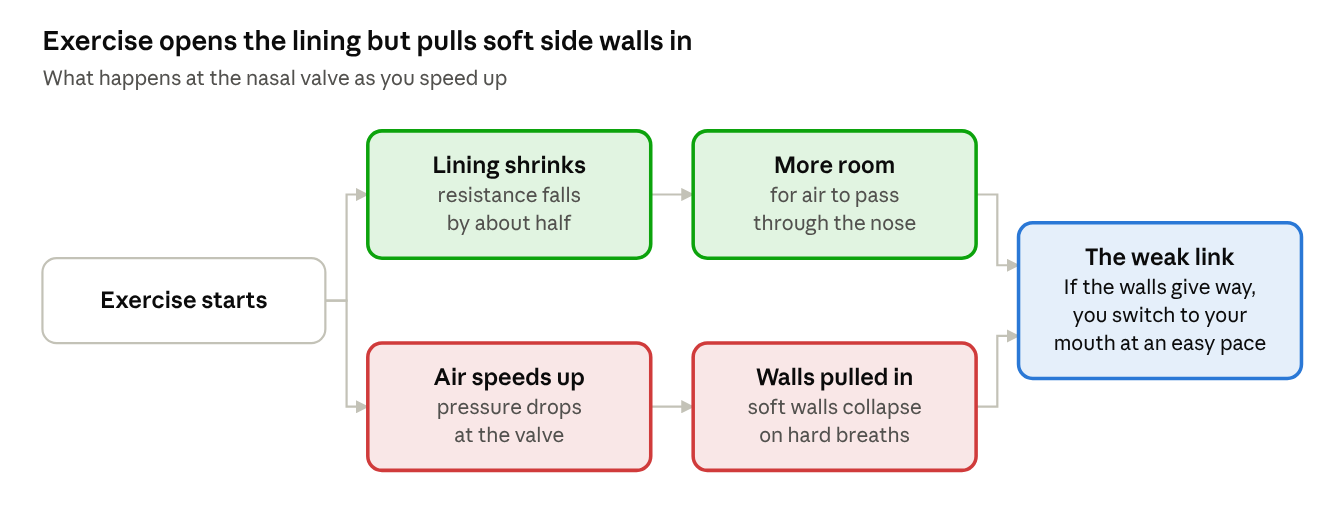
When you exercise, the inside of your nose opens up a little. But the air rushes in faster, and that pulls the soft sides of your nose inward, just inside the nostrils.
If those sides give way, your nose can't keep up, and your mouth opens even at an easy pace.
Breathing through your mouth on very hard efforts is normal. It's needing your mouth when the effort is easy that tells you something.
What it costs you
- Air that skips your nose's filter, warmth and moisture
- Airways that can tighten more, especially if you have exercise asthma
- Worse sleep and recovery
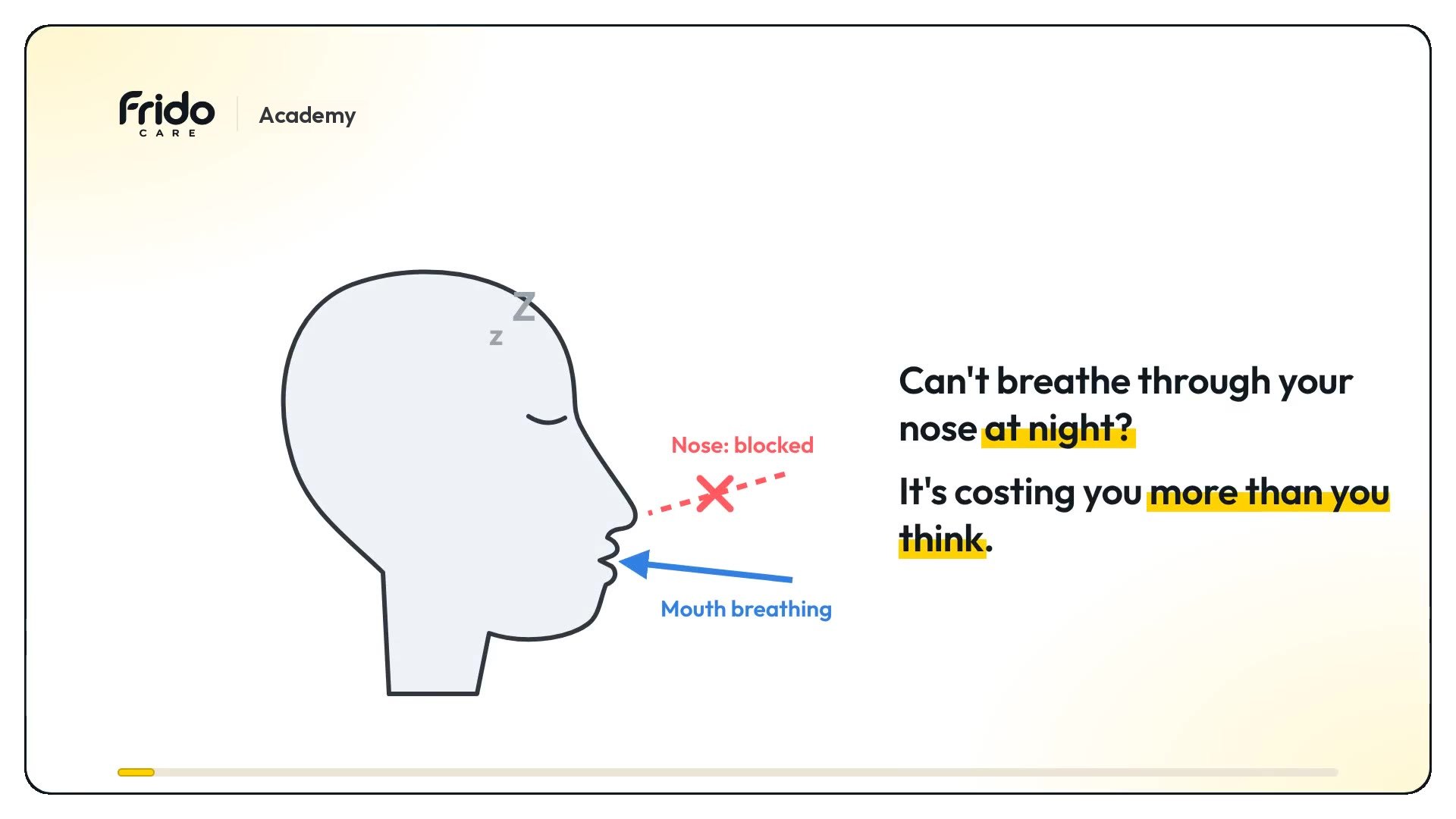
It won't slow your top speed, but it costs you everything around the workout. And it's common if you train: 7 in 10 athletes have nose trouble. If your nose also blocks at night, read Can't breathe through your nose at night?
Check yourself in two minutes
- The warm-up test. Keep your mouth closed through an easy 5-minute warm-up. If you need your mouth at an easy pace, your nose is the weak link.
- The cheek pull. Breathe in through your nose, then again while gently pulling one cheek outward. Easier with the pull? The soft sides of your nose are caving in.
- Score it. From 0 to 10, how much did your nose bother you in training this week? 5 or more: act on it.
Do all three again after two weeks of your plan, and bring the scores to your next visit.
Find your type
| If you notice... | It's likely |
|---|---|
| Itching and sneezing, worse in pollen season | An allergy swelling the lining |
| A runny or blocked nose that starts with the session, the cold or the pool | The lining reacting to exercise, cold air or chlorine |
| It's worse each time a decongestant spray wears off | The spray itself keeping the lining swollen |
| One side always worse after an old knock | The shape inside your nose |
| Pulling your cheek outward helps | Soft side walls caving in |
Quick fixes that backfire
- A decongestant spray before every session. After 5 days it makes the swelling come back worse.
- Cold and flu tablets on race day. Some contain a medicine that is banned in competition. Ask your doctor or pharmacist before you race.
- Warming up too early. The opening effect fades within 20 minutes of stopping.
What actually works: timing
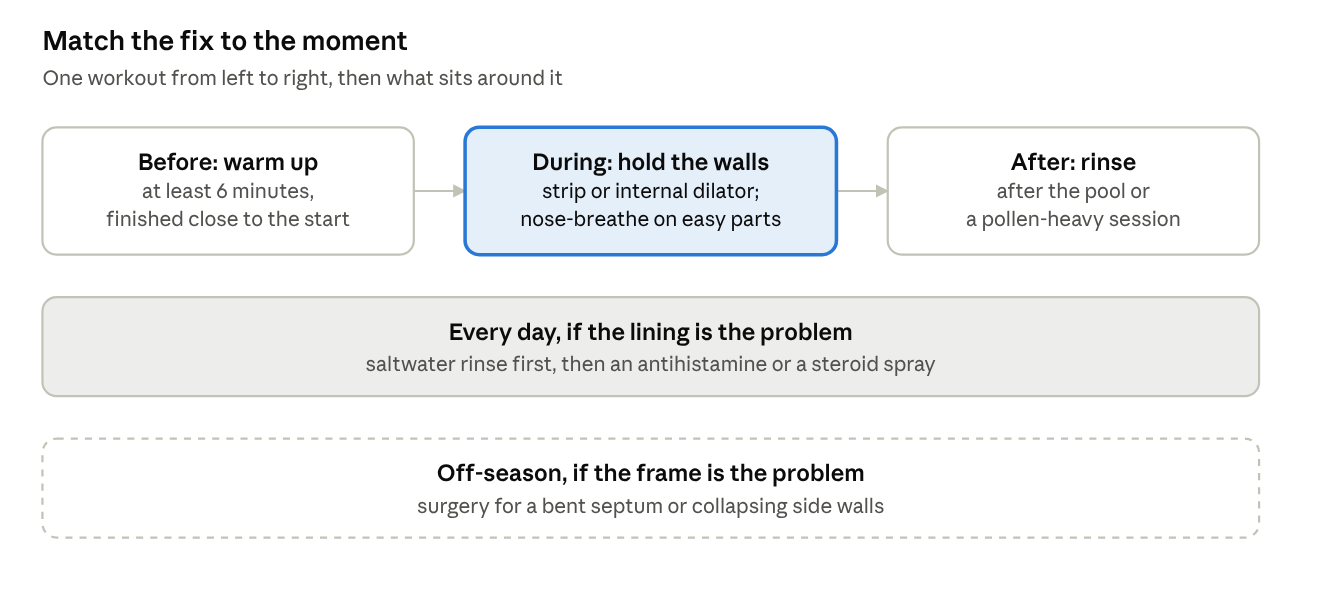
- Before: warm up, finishing close to the start. Watch a warm-up (demo video, opens in a new tab)
- During: a nasal strip holds the soft sides open.
- Every day: a saltwater rinse, and a spray if your doctor gives you one. Watch how to rinse (demo video, opens in a new tab)
- Off-season: if the shape inside your nose is the cause, a specialist may suggest surgery.
Where a Frido strip fits
A nasal strip works like a spring. It lifts the soft sides of your nose so they don't cave in on a hard breath. It helps most if the cheek pull made breathing easier.
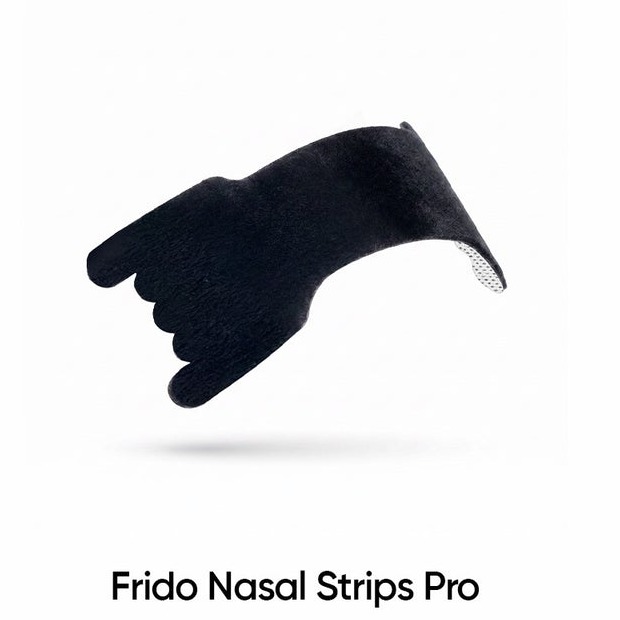
Recommended
₹499 ₹1,000 · Sweat- and oil-resistant grip for training, pack of 15
- Frido Nasal Strips (₹399): clear strips, for rest days, travel or a cold
The honest part: it holds your nose open while you wear it. It doesn't treat an allergy or a swollen lining, and it won't make you fitter or faster.
Putting it on
- Clean, dry skin, across the widest part of your nose.
- If you sweat a lot, put it on 30 minutes before the session.
- Use each strip once, and wet it before you peel it off.
Before each session
- Rinse with saltwater if you're stuffy. Watch how to do it (demo video, opens in a new tab)
- Put on a strip if the cheek pull helped.
- Warm up close to the start.
- Keep your mouth closed on the easy parts. In over 2 steps, out over 4. Watch how (demo video, opens in a new tab)
Don't use a decongestant spray for more than 5 days, and check cold tablets with a pharmacist before a race.
Breathe along
A few minutes of calm nose breathing a day helps your nose and your breathing work together. Pick an exercise and follow along.
Follow the circle: it grows as you breathe in and shrinks as you breathe out. Breathe through your nose, mouth closed, shoulders relaxed.
Ready
- Breathing control
Lie or sit back, one hand on your stomach. Breathe in gently through your nose and feel your stomach rise; breathe out through your nose, longer than the in-breath, and pause.
Breathe in 2 s→Breathe out 3 s→Pause 1 s
Source: Royal Berkshire NHS, 2025
- Short breath holds
Breathe gently through your nose, then stop and hold for a count of 2 or 3. Only as long as it doesn't make you take a bigger breath afterwards.
Breathe in 2 s→Breathe out 3 s→Hold 3 s
Source: Royal Berkshire NHS, 2025
- Easy-run rhythm
The rhythm for nose breathing on easy runs and walks: in over 2 steps, out over 4. Practise it standing first, then take it on an easy run.
Breathe in 2 s→Breathe out 4 s
Source: UCLH respiratory physiotherapy
Stop if you feel dizzy or light-headed, and shorten a hold if it makes you gasp afterwards. Cough, wheeze or chest tightness with exercise needs a doctor, not a breathing exercise.
When to see a doctor
See a doctor or your physiotherapist if:
- you cough, wheeze or your chest feels tight when you exercise
- your score is still 5 or more after a week of your plan
- nothing has changed after 6 weeks