Back & neck
Did you know your pillow can feed your spondylitis?
Most neck "spondylitis" is wear in the discs and joints that comes with age. Your pillow can't undo it, but every night it sets your neck's angle for hours. Here is what is going on, how to score your neck, and what helps.
Watch first
The whole thing in 1:42. Each part below has its own short clip.
Your plan in three stages
1Relieve
Settle the flare, in the first 2 weeks.
- Keep your neck moving gently; don't hold it still.
- Painkillers if needed, such as paracetamol or ibuprofen, as your doctor or pharmacist advises.
- No soft collar for weeks: it can weaken your neck muscles.
- Heat and massage give short-term comfort at most.
More on this: Quick fixes that backfireWhat actually works
2Restore
Keep the neck level, day and night.
- One low, firm pillow that keeps your head level with your body. Side sleepers need a taller one.
- Don't stack pillows, and don't sleep on your front.
- Take breaks from looking down at a screen.
More on this: Your pillowYour daily plan
3Reinforce
Strengthen the neck, shoulders and upper back, from week 2.
- Every day: chin tucks (demo video, opens in a new tab), isometric holds (demo video, opens in a new tab) and shoulder rolls (demo video, opens in a new tab), only to a stretch, never into strong pain.
- Score your neck again after two weeks: 5 points lower is a real change.
- Keep the habits when it settles, because it often comes back.
- See a doctor urgently for weakness, or pins and needles with neck or arm pain.
More on this: What actually worksScore your neckWhen to see a doctor
What is happening in your neck
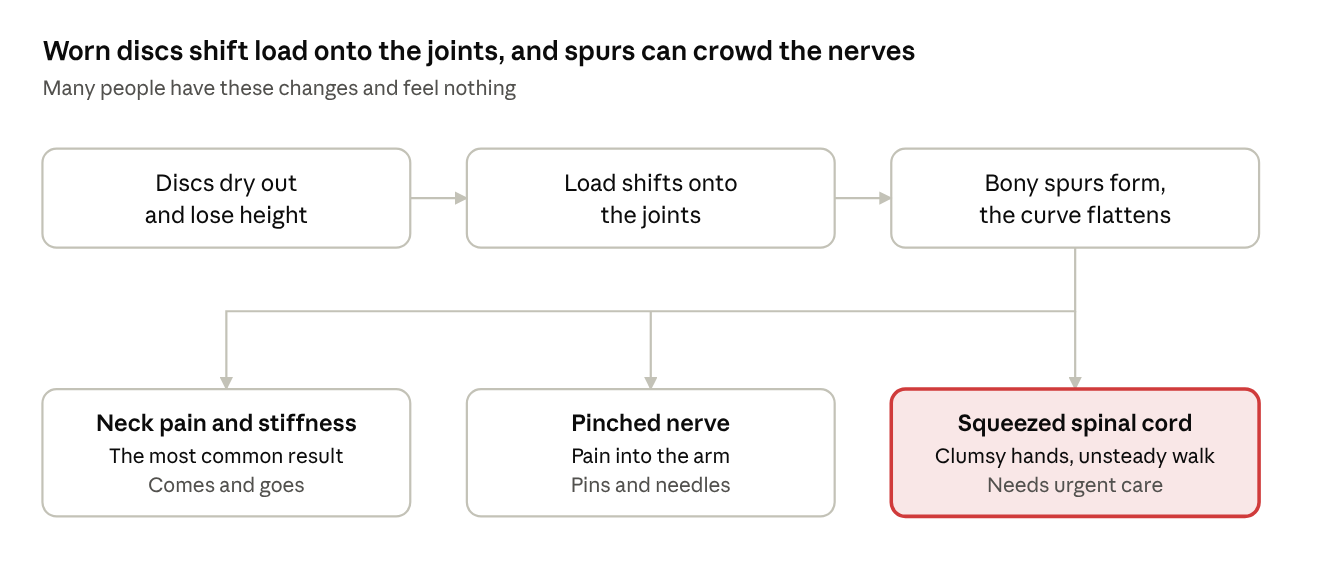
As we get older, the cushions between the bones of the neck dry out and get thinner, and the small joints behind them wear, a bit like a knee. The body adds small bony spurs.
Most of the time this causes stiffness and aches that come and go. Lots of people have the wear and feel nothing at all.
What it does to you
Neck pain and stiffness that come and go, and headaches that start at the back of your neck. It often comes back, so the habits below are worth keeping even when it settles.
Score your neck
Rate each of these from 0 (no trouble) to 5 (can't do it), and add them up, out of 50: pain, washing and dressing, lifting, reading, headaches, concentration, work, driving, sleeping and free time.
What your total means: under 5 none, 5 to 14 mild, 15 to 24 moderate, 25 or more severe. Score again after two weeks; 5 points or more lower is a real change.
Spondylosis or spondylitis?
People often say "spondylitis" when they mean neck wear (spondylosis). True spondylitis (ankylosing spondylitis) is a different, inflammatory illness that usually starts in teens or young adults, with back stiffness that builds over months. If that sounds like you, tell your doctor.
Quick fixes that backfire
- A soft collar for weeks: it can weaken your neck muscles.
- Stacking pillows: it bends your neck forward all night. Use one low, firm pillow.
- Keeping your neck still: keep it moving, gently.
What actually works
Gentle exercise that strengthens your neck, shoulders and upper back helps most. Do them daily, only until you feel a stretch, never into strong pain.
- Chin tuck: draw your chin straight back and hold 5 to 10 seconds. Watch how (demo video, opens in a new tab)
- Side bend: ear towards shoulder, hold 5 seconds, 5 each side. Watch how (demo video, opens in a new tab)
- Head turn: look over each shoulder, hold 5 seconds, 5 each side. Watch how (demo video, opens in a new tab)
- Isometric holds: push your head into your hand without moving, hold 5 to 10 seconds. Watch how (demo video, opens in a new tab)
- Shoulder rolls: both directions, 5 times. Watch how (demo video, opens in a new tab)
Your pillow
Use one low, firm pillow that keeps your head level with your body. On your back, a low pillow does that; on your side, you need a taller one. Ask someone to check that your head lines up with your body, and give a new pillow 1 to 2 weeks.
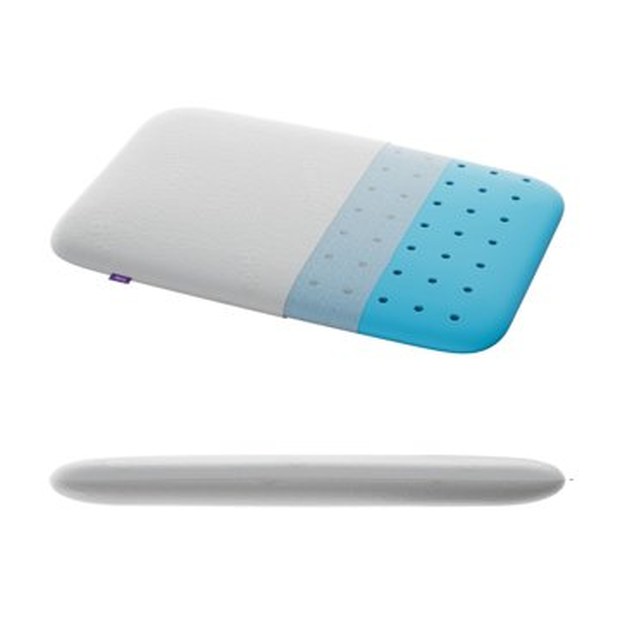
Recommended
Frido Ultra Slim Deep Sleep Pillow
₹1,499 ₹3,299 · 50.6 mm gel memory foam, for back sleepers
- Frido Ultimate Cervical Pillow (₹1,199): taller, for side sleepers
Your daily plan
- The five neck exercises, every day.
- Keep moving through the day; take breaks from looking down at a screen.
- One low pillow at night, head level. No collar to bed, and not on your front.
When to see a doctor
See a doctor urgently for heaviness or weakness in your arms or legs, pins and needles with neck or arm pain, or pain between your shoulder blades.