
Clinical protocol Nose & breathing
Blocked nose at night (nasal obstruction)
A blocked nose at night pushes patients to breathe through the mouth, which brings snoring, a dry mouth and tired mornings. Most of the blockage sits at the nasal valve. How to measure it, find the cause, choose between calming the lining, holding the walls open, and fixing the frame.
Filed underNasal obstructionNose
Patient explainer
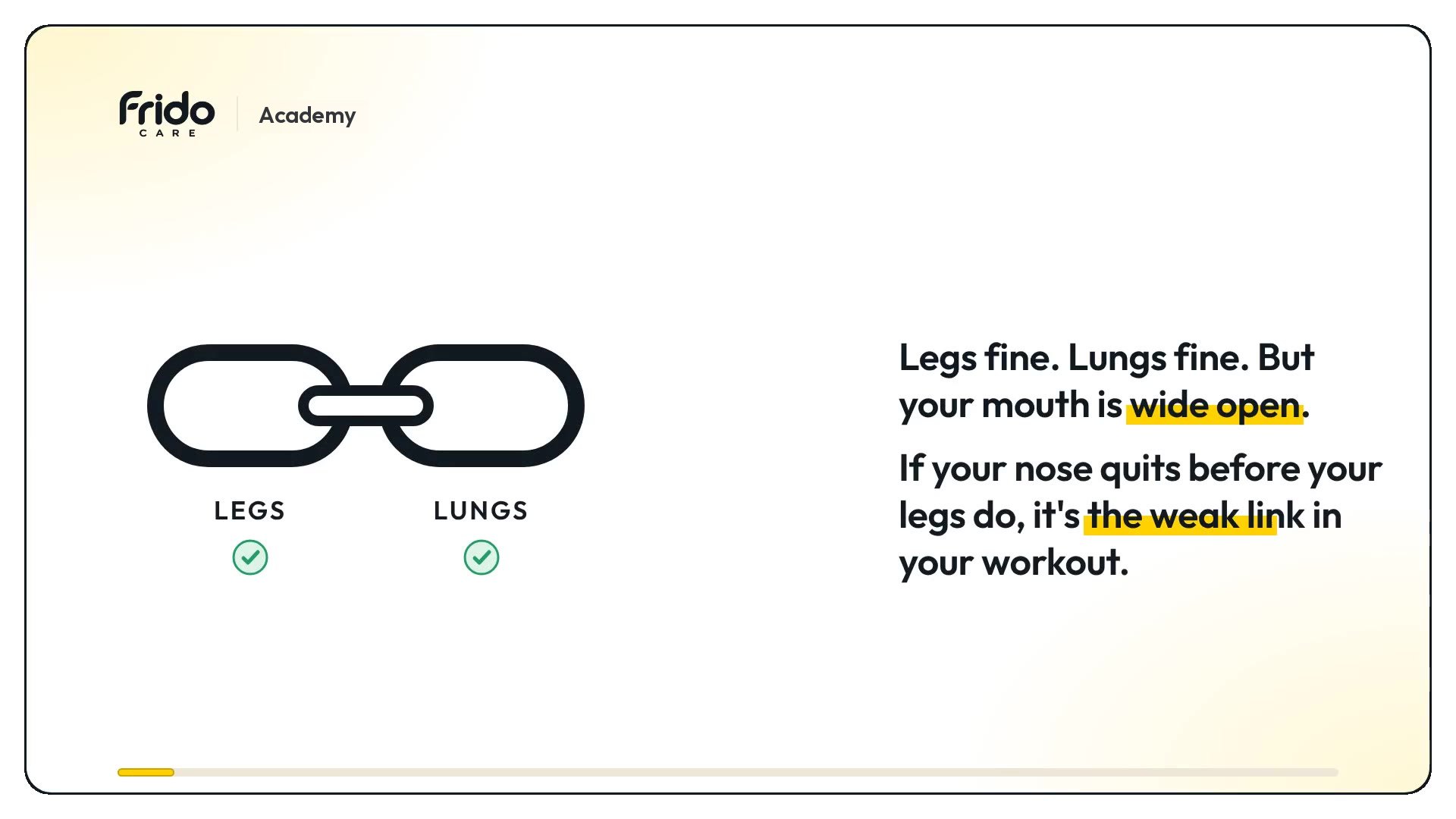
A 1:55 explainer with every key point on screen. Play it in the session, or send the patient view: the same video with a self-check and the nightly plan, and nothing clinical.
Clinical summary
- What it is
- Obstruction concentrated at the nasal valve, the narrowest segment of the airway and about half of nasal resistance. A soft lateral wall is drawn inward on each breath in.
- Why it matters
- Congestion on 5 or more nights a month goes with habitual snoring, daytime sleepiness and unrefreshing sleep; allergic congestion carried 1.8 times the odds of moderate to severe sleep-disordered breathing.
- Measure
- NOSE score (0 to 100) at baseline and after two weeks: 30 to 50 moderate, 55 to 75 severe.
- Assess
- History, NOSE, the lateral walls on a quiet breath in, the cheek-pull (Cottle) test and, if available, peak nasal inspiratory flow with and without a strip.
- First line
- Calm the lining: saline rinse, intranasal steroid if allergic, decongestant for 5 days at most, head raised. At least 6 weeks before ENT referral.
- Refer
- Urgently for one-sided bloody discharge, foul smell, cheek numbness, visual or dental change, or neurological signs; to a sleep clinic for pauses or gasping in sleep.
Night-time adjunct
Frido Nasal Strip Pro ₹499 ₹1,000
Nasal Strips for occasional use, such as a cold or a flight.
Holds the valve open while worn. It doesn't treat the lining, the septum or sleep apnoea.
The plan in three stages
1Relieve
Open the nose tonight.
- Rinse with saltwater if you're stuffy. Watch how (demo video, opens in a new tab)
- Sleep with your head raised.
- If pulling your cheek outward helps you breathe, wear a nasal strip at night.
- Skip the fixes that backfire: no decongestant spray for more than 5 days, no menthol rubs, no taping your mouth.
More on this: Opening the nose: the optionsWhere the Frido Nasal Strip Pro fits
2Restore
Keep the nose open, night after night.
- Find your type: an allergy, a spray rebound, the shape inside the nose, soft side walls, or lying flat.
- If you were given a steroid spray, use it every day: it takes days to weeks to work.
- Keep to the nightly plan: rinse, spray if prescribed, strip if it helps, head raised.
More on this: Why it happensAssessment, referral and plan
3Reinforce
Train the airway and check your progress.
- If you snore, do the tongue and throat exercises every day. Watch how (demo video, opens in a new tab)
- Score your nose now and again after two weeks of the plan.
- Go back to your physio or doctor if one side is always blocked or nothing has changed after 6 weeks.
More on this: Measuring it: the NOSE scoreExercises and routines that help
What a blocked nose at night is
Most of the blockage sits at the nasal valve, a narrow slit just inside the nostrils between the soft side wall, the septum and the lower turbinate. It is "the bottleneck of the nose" and causes almost half of its resistance to airflow. Air speeds up through the slit, pressure drops, and a soft side wall gets sucked inward on each breath in (Bloching 2008).
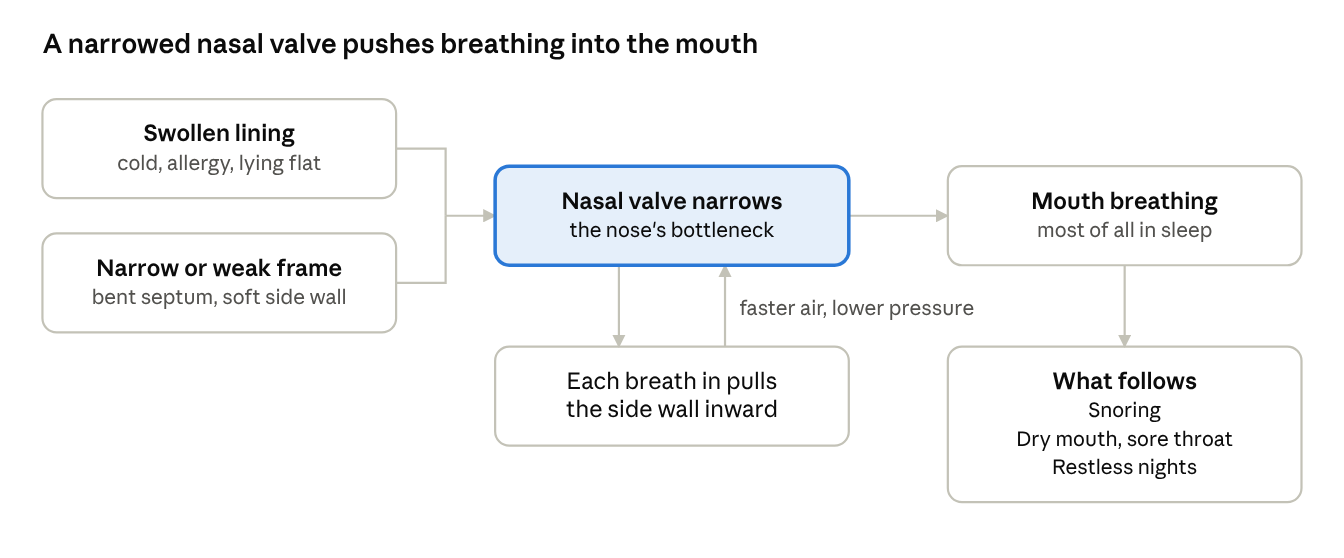
Typical signs: mouth breathing at night, snoring, waking with a dry mouth or sore throat, and nostrils that cave in on a normal breath in.
How it affects the patient
In a study of 4,927 adults, a stuffy nose on 5 or more nights a month went with snoring most nights, daytime sleepiness and waking unrefreshed. Allergy-related congestion carried 1.8 times the odds of moderate to severe breathing problems in sleep (Young 1997).
Measuring it: the NOSE score
Five items, each rated 0 (no problem) to 4 (severe) for the past month; add them up and multiply by 5 (NOSE scale, AAO-HNS). It takes the patient 30 seconds, and the patient view carries it as a self-check.
| Over the past month, how much of a problem was... | Score (0–4) |
|---|---|
| Nasal congestion or stuffiness | |
| Nasal blockage | |
| Trouble breathing through my nose | |
| Trouble sleeping | |
| Not enough air through my nose during exercise |
5 to 25 is mild, 30 to 50 moderate, 55 to 75 severe and 80 to 100 extreme (BackTable). Score again after two weeks of whatever you try.
Why it happens
Anything that swells the lining or narrows the frame shrinks the valve, and the clue usually tells you which.
| Cause | What it does | The clue |
|---|---|---|
| Allergy (dust mites, pollen, pets, mould) | Swells the lining within minutes of contact (NHS) | Sneezing and itchy eyes |
| Irritants and hormones (smoke, fumes, weather, pregnancy) | Swells the lining without an allergy (NHS) | Starts with the trigger |
| Decongestant spray used too long | Rebound swelling after 5 to 7 days of daily use, sometimes 3 (StatPearls) | Worse each time the spray wears off |
| Bent septum or large turbinates | A fixed narrowing at the valve (Bloching 2008) | One side always worse |
| Weak side walls (ageing, past surgery) | The side wall is sucked in with each breath (Bloching 2008) | Pulling the cheek outward helps |
| Lying flat | Nasal resistance rose on lying down in all 12 studies that measured it (Calvo-Henríquez 2021) | Worse at night than in the day |
How it's diagnosed
Put what the patient feels next to what the nose shows, because the two often disagree (Yepes-Nuñez 2013). That means the history and NOSE score, a look inside the nose with the cheek-pull (Cottle) test, and if needed a sniff-flow test, a camera exam (nasal endoscopy) or allergy tests (Ottaviano 2019; West Suffolk NHS; NHS North West Allergy Network). A sleep study is needed when snoring comes with pauses or gasping (NHS).
| Often called | What it might be | What points to it |
|---|---|---|
| "Just snoring" | Sleep apnoea | Pauses, gasping or choking in sleep and heavy daytime tiredness (NHS) |
| "A cold that won't clear" | Allergy | Sneezing and itchy eyes around dust, pets or pollen (NHS) |
| "I need my spray" | Rebound congestion | The block returns worse as each dose wears off; stopping the spray is the treatment (StatPearls) |
Opening the nose: the options
Leaving it rarely works: the body just switches to mouth breathing, and pulling harder through a narrow valve sucks the side walls further in (Bloching 2008). Three quick fixes backfire:
- A decongestant spray every night: used for more than 5 days, it can make the block worse (NHS).
- Menthol rubs: the nose feels clearer (Eccles 2003), but feeling open and being open are separate things (Jones 1989).
- Taping the mouth shut: it forces nose breathing without opening the nose, and is risky when the nose is blocked (Rhee 2025).
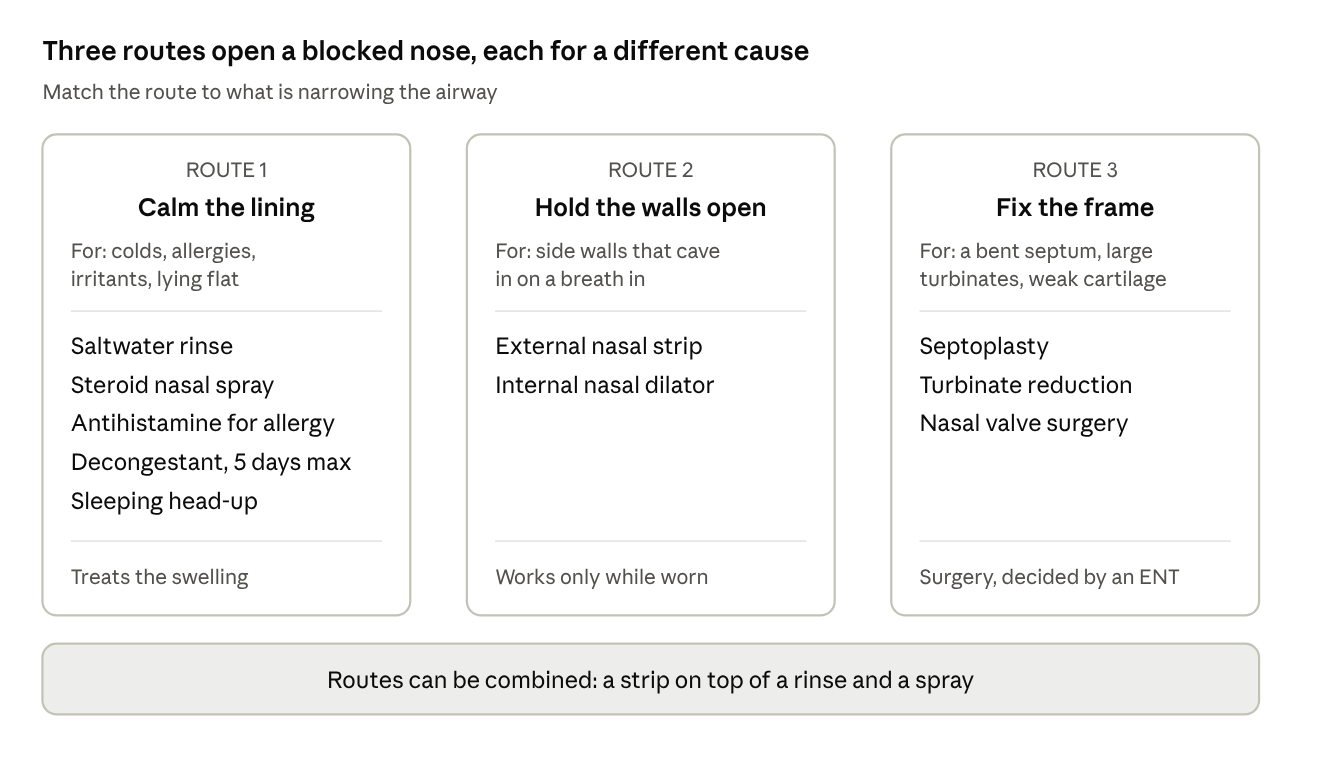
What does work falls into three routes.
| Route | Options | What the evidence shows |
|---|---|---|
| 1. Calm the lining | Saltwater rinse (demo video, opens in a new tab), steroid spray, antihistamine for allergy, decongestant for 5 days at most, sleeping head-up | Rinsing eased hay-fever symptoms across 14 trials (Head 2018); a steroid spray is the first treatment for seasonal allergies but needs daily use for days to weeks (AAAAI/ACAAI; NHS) |
| 2. Hold the walls open | External nasal strip, internal nasal dilator | Peak sniff airflow was 66 litres a minute with nothing, 102 with a strip and 139 with an internal dilator (Dinardi 2014); neither lowers sleep apnoea counts (Camacho 2016) |
| 3. Fix the frame | Septoplasty, turbinate or valve surgery | In 378 adults with a bent septum, surgery beat sprays: symptom scores of 19.9 against 39.5 at 6 months, lower being better (NAIROS, Carrie 2023) |
NHS guidance tries rinses and steroid sprays for at least 6 weeks before referring on (NHS Tayside).
Where the Frido Nasal Strip Pro fits
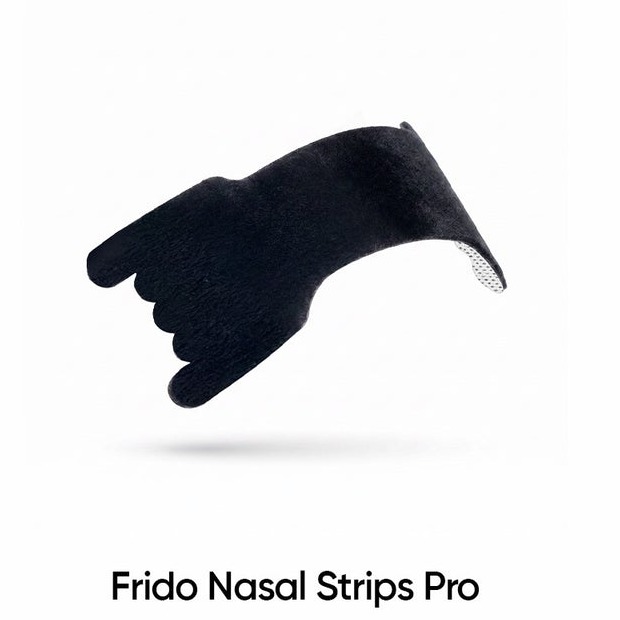
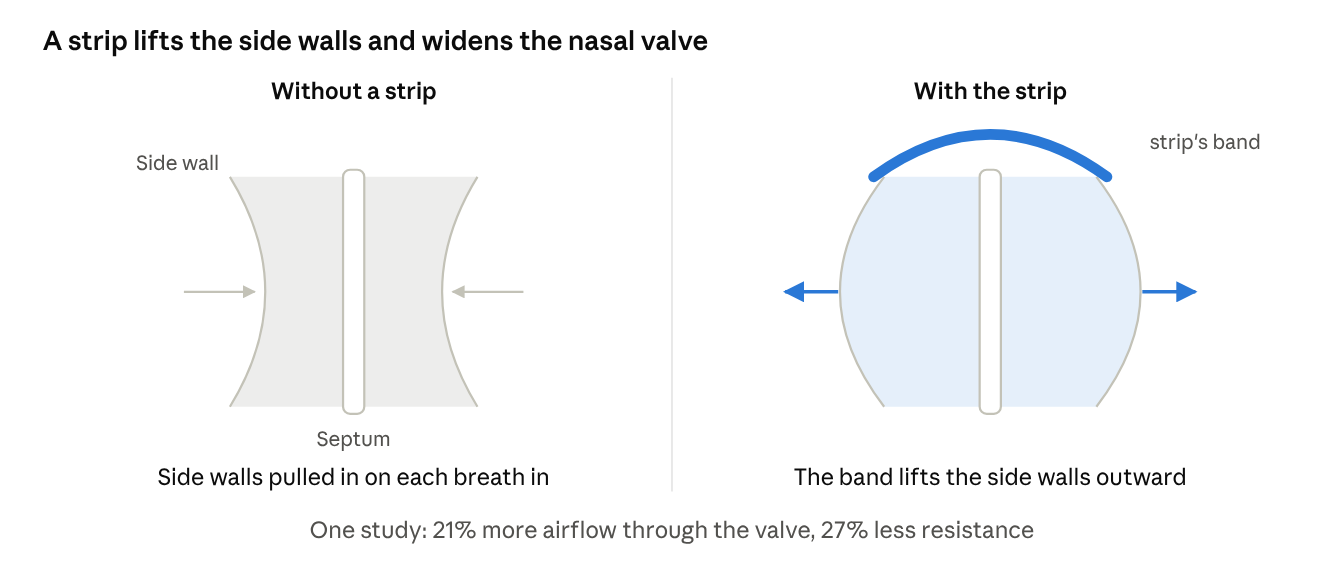
Frido's option sits in route 2. A strip works like a leaf spring: it lifts the side walls outward and holds the valve open on each breath in (Bloching 2008). In one study a strip raised airflow through the valve by 21% and cut resistance by 27% (Dinardi 2014).
| Nasal Strips | DefaultNasal Strip Pro | |
|---|---|---|
| Price for 15 (MRP) | ₹399 | ₹499 |
| Build | Transparent strip | Breathable black non-woven fabric |
| Grip | Up to 12 hours | Stronger sweat-resistant adhesive, up to 12 hours |
| Rating | 4.6/5 (317 reviews) | 4.7/5 (472 reviews) |
| Best for | Occasional use, such as a cold or a flight | Overnight wear, the use it is designed for |
Prices as listed on myfrido.com on 15 Oct 2026; check the product page for today's price.
Neither strip clears mucus, treats an allergy or straightens a septum.
Does the strip solve the main problem?
It fixes one cause of a blocked nose at night, side walls caving in at the valve, and only while it's on.
| Part of the problem | Solved? | Why |
|---|---|---|
| Side walls caving in | Yes, while worn | Holds the walls out (Dinardi 2014) |
| Swollen lining | No | Works on the outside walls only; route 1 treats the lining (Bloching 2008) |
| Bent septum | No | Can't move the septum (Bloching 2008) |
| Snoring | Sometimes | Eased it in long-term rhinitis (Dinardi 2014), but not in snorers using strips with breathing exercises (Ieto 2015) |
| Sleep apnoea | No | No drop in apnoea counts across 14 studies (Camacho 2016) |
Can say: holds the front of the nose open while you sleep; drug-free; works alongside rinses and sprays. Can't say: cures a blocked nose, treats sleep apnoea, stops snoring, boosts sports performance (Dinardi 2020) or "clinically proven". We found no study of Frido's own strips.
Which Frido strip to choose
Best fit: the Pro. A strip only works while it stays on, and the Pro has the stronger grip Frido designs for overnight wear (Frido). The regular strip suits occasional use, such as a cold or a flight.
Make it work: wash and dry the nose, place the strip across the widest part just above the nostril flare, and wet it before peeling it off (Frido). Suggest it when the cheek-pull test helps: that is the patient whose side walls are part of the problem.
In the Frido Care app, add a strip to the plan only when your findings call for one; you accept, edit or drop every suggestion. Frido ships it to the patient directly.
Assessment, referral and plan
Assess: history, NOSE score, the side walls on a quiet breath in, the cheek-pull test and, if available, peak nasal inspiratory flow with and without a strip (Bloching 2008; Ottaviano 2019).
SettleWeeks 0–2
- Saltwater rinse (demo video, opens in a new tab); stop decongestant overuse (NHS GGC).
- A steroid spray from a pharmacist or doctor if allergic.
- Head raised at night.
- A strip at night if the cheek-pull test helps.
RestoreWeeks 2–6
- Daily steroid spray.
- Tongue and throat exercises (demo video, opens in a new tab) if snoring (Ieto 2015).
- Re-score NOSE.
ReviewWeek 6 on
- Score below 30: keep what works.
- Still 30 or more, or one-sided: refer to ENT (NHS Tayside).
Talking to the patient
Explain it in plain words
"Just inside your nostrils is a small doorway, the nasal valve. When the lining swells or the soft sides get sucked in, it closes, and you breathe through your mouth, which brings the snoring and the tired mornings. Once we know what's closing it, there's a fix for each cause."
Their nightly routine
Rinse if stuffy, use the steroid spray if prescribed, put on a strip if pulling the cheek outward helps, and sleep with the head raised (Calvo-Henríquez 2021). No mouth taping (Rhee 2025), and no decongestant for more than 5 days (NHS). Re-score after two weeks.
Send the patient view
The patient view has the explainer, the NOSE self-check, the nightly plan and the safety-net in plain words, and leaves out everything clinical. Send it with Send to patient at the top of this page, or switch to it with the toggle to go through it together.
Exercises and routines that help
| Exercise | How much | Demo | How-to |
|---|---|---|---|
| Tongue and throat exercises | 2–3 sessions a day, at least 10 minutes in total, for about 3 months | Watch (demo video, opens in a new tab) | Sleep Foundation |
| Nose-breathing practice | Mouth closed, one nostril at a time | Watch (demo video, opens in a new tab) | Sleep Foundation |
| Saltwater rinse | 3 times a day until clear, up to 2 weeks | Watch (demo video, opens in a new tab) | NHS ENT leaflet |
In a 3-month trial, tongue and throat exercises roughly halved measured snoring (Ieto 2015); a Cochrane review found smaller gains (Cochrane 2020).
Sources
- Disorders of the nasal valve area, Bloching MB. GMS Current Topics in Otorhinolaryngology, Head and Neck Surgery, 2008
- Nasal obstruction as a risk factor for sleep-disordered breathing, Young T, Finn L, Kim H. Journal of Allergy and Clinical Immunology, 1997
- NOSE instrument, American Academy of Otolaryngology–Head and Neck Surgery
- NOSE score bands, BackTable
- Allergic rhinitis, NHS
- Non-allergic rhinitis, NHS
- Sleep apnoea, NHS
- Mometasone nasal spray, NHS
- Rhinitis Medicamentosa, StatPearls
- Positional nasal congestion: sleep apnea's forgotten cousin, Calvo-Henríquez C et al. Archivos de Bronconeumología, 2021
- Assessment of nasal obstruction: correlation between subjective and objective techniques, Yepes-Nuñez JJ et al. Allergologia et Immunopathologia, 2013
- Peak nasal inspiratory flow measurement and visual analogue scale in a large adult population, Ottaviano G et al. Clinical Otolaryngology, 2019
- Flexible nasendoscopy leaflet, West Suffolk NHS
- Diagnosing allergy, NHS North West Allergy Network
- Menthol: effects on nasal sensation of airflow and the drive to breathe, Eccles R. Current Allergy and Asthma Reports, 2003
- Nasal airflow: resistance and sensation, Jones AS, Willatt DJ, Durham LM. Journal of Laryngology & Otology, 1989
- Mouth taping: a systematic review, Rhee J et al. PLOS ONE, 2025
- Saline irrigation for allergic rhinitis, Head K et al. Cochrane Database of Systematic Reviews, 2018
- Treatment of seasonal allergic rhinitis: AAAAI/ACAAI guideline, Hauk L. American Family Physician, 2018
- External nasal dilators: definition, background, and current uses, Dinardi R et al. International Journal of General Medicine, 2014
- Nasal dilators for snoring and OSA: a systematic review and meta-analysis, Camacho M et al. Pulmonary Medicine, 2016
- Does the external nasal dilator strip help in sports activity?, Dinardi R et al. European Archives of Oto-Rhino-Laryngology, 2020
- Septoplasty versus medical management for nasal airways obstruction (NAIROS), Carrie S et al. BMJ, 2023
- Nasal block (adult) referral guidance, NHS Tayside
- Rhinitis referral guidance, NHS Greater Glasgow and Clyde
- Effects of oropharyngeal exercises on snoring: a randomized trial, Ieto V et al. Chest, 2015
- Myofunctional therapy for obstructive sleep apnoea, Cochrane, 2020
- Nasal douching leaflet, University Hospitals Sussex NHS, 2025
- Mouth exercises to stop snoring, Sleep Foundation
- Frido Nasal Strip Pro, myfrido.com (prices as of 15 Oct 2026)
- Frido Nasal Strips, myfrido.com (prices as of 15 Oct 2026)
For physiotherapists and doctors
Use these guides with your patients
Every guide has a plain-language patient view and a printable home guide to share after a session. Certifications & Training, leading to Frido Verified Partner, is coming soon.